
If you want see real results from your exercise routine, how you measure effort matters. While this can be difficult to do on your own, there’s a simple tool that’s beneficial for experienced athletes and everyday exercisers alike: Rate of Perceived Exertion. This method of tracking intensity doesn’t rely on fancy heart rate monitors or fitness trackers — it uses something arguably more valuable: your own internal feedback.
Whether you’re working with a personal trainer or exercising on your own, understanding and using RPE can make your workouts more effective, personalized, and sustainable.
THE BASICS OF RPE
“Your rate of perceived exertion (RPE) refers to how hard you think you’re pushing yourself during exercise. It’s subjective, which means that you decide how hard you feel you’re working during physical activity. The RPE scale was developed by Swedish researcher Gunnar Borg in the 1960s. It’s sometimes called the Borg Rating of Perceived Exertion” (Cleveland Clinic, 2023).
The method asks you to rate your effort on a scale — usually from 1 to 10 — based on how challenging a particular exercise feels. A rating of 1 represents minimal effort, such as a gentle walk, while a rating of 10 represents maximal effort: something you couldn’t sustain for more than a few seconds. The simplicity of this system makes it incredibly versatile and easy to implement in any fitness program, regardless of your experience or equipment access.
WHY RPE MATTERS
Using RPE allows you to tune into your body and adjust your workouts accordingly. Unlike objective tools like heart rate monitors, RPE accounts for the full picture of what’s happening in your body on a given day. This includes the consideration of fatigue, stress, sleep quality, hydration, and nutrition.
THE BENEFITS OF RPE
RPE provides several important benefits that can elevate your training experience, no matter your goals or fitness level. First of all, it helps you avoid overtraining. If your in-home or virtual personal trainer notices that your RPE is consistently high for exercises that should be moderately challenging, it may signal that you need more recovery time.
On the other hand, if your RPE is consistently low, your trainer may decide it’s time to increase your training intensity or load. Secondly, RPE empowers you to listen to your body. Some days, even light exercises can feel difficult due to factors outside the gym (like stress at work or a poor night’s sleep). RPE allows you to adapt on the fly without feeling guilty about taking it easier when needed.
Finally, RPE is a powerful motivational tool. When you track your perceived effort over time, you’ll notice improvements not just in your physical capacity but also in your self-awareness. For example, a workout that once felt like a 9 may start to feel more like a 6 as your fitness improves. That’s tangible progress you can feel and celebrate.
PERSONAL TRAINING
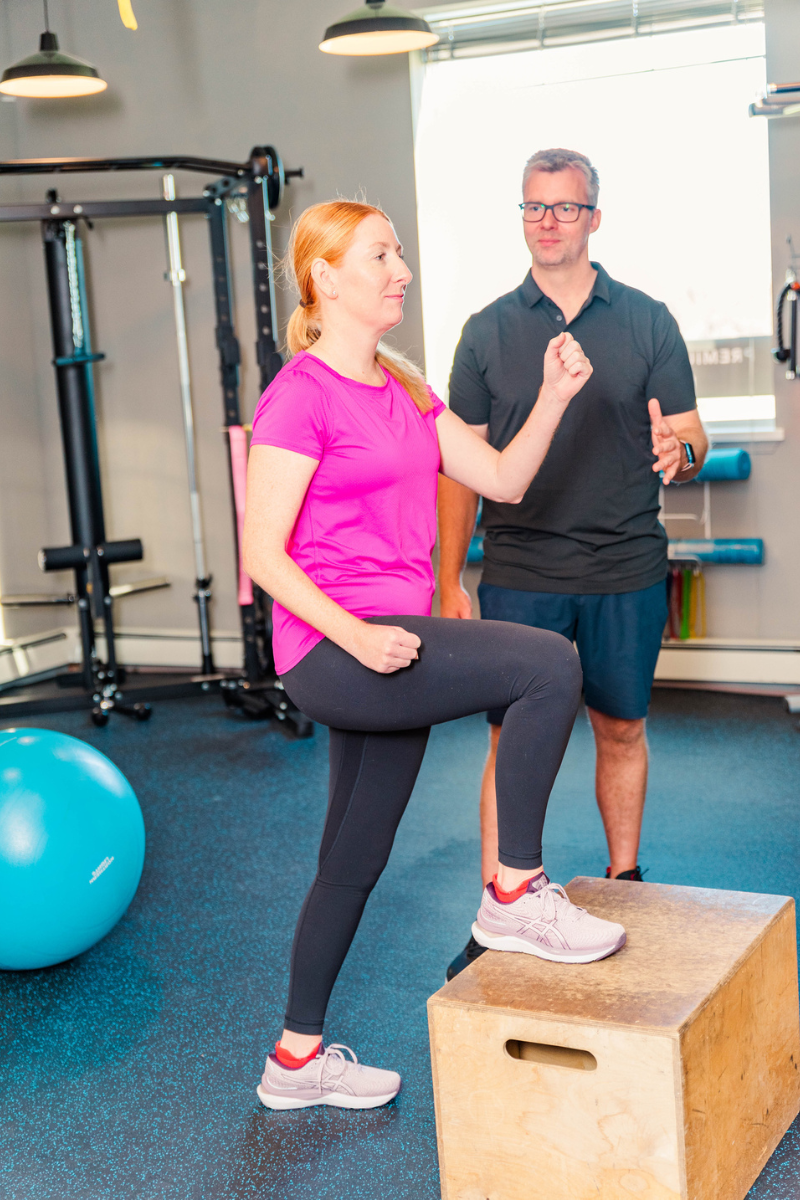
Both virtual personal trainers and our in-home personal trainers in Toronto, Collingwood, London, Hamilton, and Ottawa use RPE as a valuable communication and programming tool. For example, if a client is aiming to build endurance, a trainer might ask them to keep their RPE between 4 and 6 during cardio sessions. If strength-building is the goal, a trainer may look for sets that land around an RPE of 7 to 9. By adjusting exercises, repetitions, and rest periods based on RPE, trainers can create a program that adapts with a client’s progress.
RPE is especially valuable for people working with a virtual personal trainer. When clients are on camera, trainers can’t always see detailed facial expressions or the subtle changes in breathing seen in-person. When RPE is reported accurately, we can understand how challenging the workout really feels for you and make the necessary adjustments to your routine. This is why constant communication is key: if we can hear you talking, it gives us a good idea of how you’re feeling. It also helps build trust, as clients learn to check in with their own physical and mental state.
OUR TIPS
Even if you’re not working with an in-home or virtual personal trainer, you can start using RPE right away to become more in tune with your fitness. After each set or exercise, simply ask yourself, “How hard was that on a scale of 1 to 10?” Over time, you’ll begin to notice patterns and develop a clearer sense of what different levels of effort feel like.
If you’re training for general fitness or fat loss, your goal may be to hover around an RPE of 6 to 8 for most of your workouts. For strength training, the target may be closer to 7 to 9 during your final reps of each set. During active recovery days or lower-intensity sessions like walking or yoga, you might aim for an RPE of 3 to 4.
THE ADVANTAGES OF RPE
While RPE is not a replacement for all tracking methods, it complements them well. For example, you can use a heart rate monitor to track cardiovascular effort and combine that data with RPE to get a more complete picture. A heart rate of 150 bpm might feel like an RPE of 6 one day and an 8 on another, depending on factors like hydration, sleep, and nutrition. This helps you adjust your training with a more holistic view of your body’s current capacity.
Similarly, lifters often combine RPE with numbers like sets, reps, and weights. This is especially useful when using a method known as “autoregulation,” where the weight lifted is adjusted based on how hard the movement feels that day, as “fluctuations of physiological variables such as hormonal and muscle damage biomarkers could affect daily or weekly strength fluctuations” (National Library of Medicine, 2021). If you’re supposed to lift at an RPE of 8 for 5 reps, you might choose a weight that leaves you with only 2 reps left in the tank. This method keeps you progressing without pushing too far or risking injury.
“Another researched method of measuring exertion that often sits alongside the RPE method is the RIR scale. This simply means ‘Reps In Reserve’. With this scale, RPE is flipped on its head, with one meaning ‘one rep in reserve’. For example, you complete a set of 10 reps at a moderate weight. At the end of the set, you estimate you could have completed five more reps. This means you have five reps in reserve” (Men’s Health, 2024).
FINAL WORDS
RPE is a powerful, intuitive tool that enhances your connection to your body while supporting safe, effective workouts. If you’re looking for personalized guidance on how to incorporate RPE into your fitness plan, working with an in-home or virtual personal trainer can be a game-changer. If you’re ready to start training smarter, book your free initial session with Nielsen Fitness, here!