PREMIUM IN-HOME, STUDIO & VIRTUAL PERSONAL TRAINING

REQUEST A FREE FIRST WORKOUT

Personal Trainers in Toronto — In-Home, Studio & Virtual | Including Seniors & Adults 50+

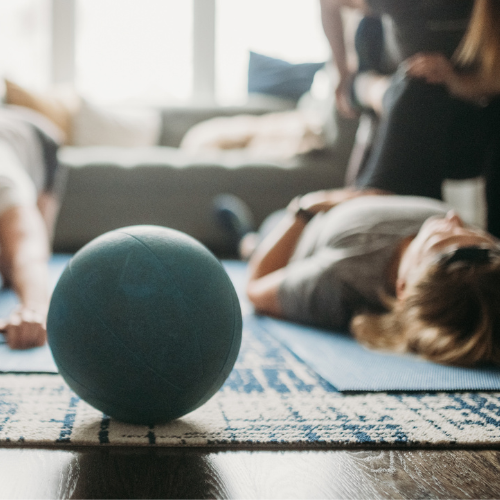
Nielsen Fitness has been Toronto’s trusted personal training company since 2006. We offer premium in-home personal training in Toronto, studio personal training, and live virtual training available anywhere in Canada. We work with clients of all ages and fitness levels, with a specialization in personal training for seniors, adults 50+ and those with special or unique needs (chronic pain, injury rehab, etc.).  

 
Premium in-home personal trainer in Toronto, Collingwood, Hamilton, London, and Ottawa. Personal virtual trainer.

Toronto In Home In Studio Virtual personal training

Whether you prefer working out at home, training in our private studio, or joining a live virtual session from anywhere — Nielsen Fitness has a program that fits your life. Our certified personal trainers in Toronto are matched to your goals, schedule, and fitness level.

work with us...

available in:

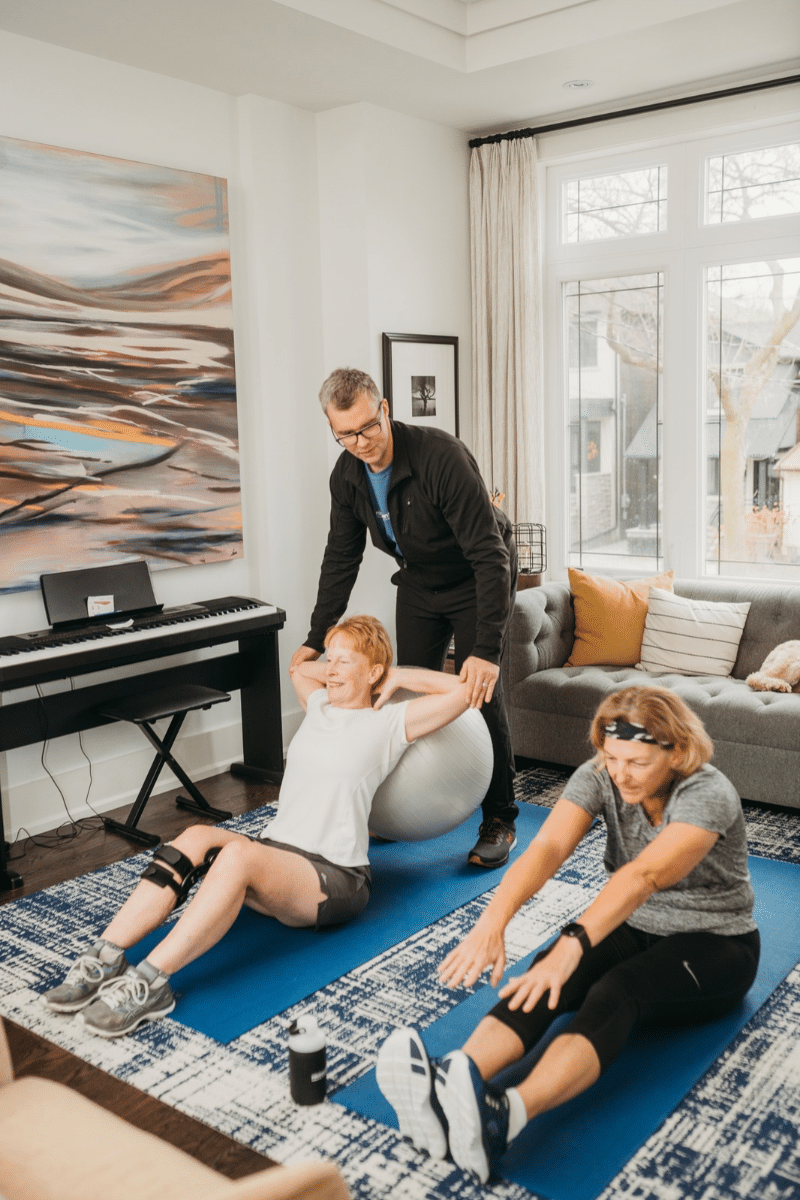
We’ve been training clients in Toronto since 2006 with a specialization in older adults and those with special or unique needs. We work with clients in their homes and condos across the GTA and have a fully-equipped private studio in Leaside for those who prefer to exercise outside the home. Plus, for those looking for flexibility and convenience, our online fitness trainer services make it easy to stay active from anywhere. Click below to learn more!

Looking for personal training for seniors in a private studio setting, or an in-home personal trainer serving Toronto and beyond?

Our personal training for the elderly and seniors is designed to build strength, improve balance, and support independence, with programs tailored to your pace, abilities, and goals. Whether in-studio or in the comfort of your own home, our trainers bring the same expert, personalized approach to every session.

The same premium personal training Toronto clients have trusted since 2006 is also available throughout the region. We’ve got you covered.
available in:

We’ve been training clients in Toronto since 2006 and we’re pretty excited to now be serving our friends down the QEW in Hamilton also! Though we train clients of all ages and fitness levels, we specialize in in-home and virtual training for the elderly, adults 50+ and those with special or unique needs. Click below to learn more!


Virtual Personal Training: Live, Effective, Available Anywhere in Canada.

 Enjoy the same incredible results, expert trainers, and (awesome) experience as you’d get in person – all from the comfort of your home with a virtual personal trainer. It’s as simple as logging into a video call. All you need is a screen (laptop or tablet), Internet connection and a small amount of space. You get online personal training in Canada — from a team with 20 years of experience.
Since starting with Nielsen Fitness three years ago, I’ve lost 25 pounds of fat, gained lean muscle, and am now in the best shape of my life. Having routines that are varied and challenging keep it fresh, and the quarterly assessments provide proof of progress. 

Barry N.

I wouldn’t be where I am today without Poul and the team at Nielsen Fitness. If you’re looking for honesty, integrity and a long-term partner with your physical health, give them a call.

Rob H.

I started with Nielsen Fitness a few years ago, wanting to work on balance, flexibility and strength after hitting the big ‘5-0’. As a busy professional and have never found time for the gym, but the formula at Nielsen is fantastic, combining the convenience of in-home workouts with awesome trainers.

Heather E.

When I first approached Nielsen Fitness, I was hesitant as I had bad experiences with other gyms and trainers before – but from the first meeting with Poul I realised I had no reason to be. He listened to my fears and asked all the right questions. Before I knew it, I was seeing changes in not only my posture, but my overall health.

L. Murphy

We started with Nielsen Fitness seven years ago and have been happy, healthier customers ever since. Our strength and fitness level has improved tremendously. We highly recommend the service to anyone looking to improve their general well-being or trying to meet specific fitness targets.

Dan M.

About Nielsen Fitness — Toronto Personal Training Since 2006

Nielsen Fitness was one of the first in-home personal training companies to set up shop in Toronto back in 2006. Since then, we’ve built a community of thousands of happy clients, expanded both our offerings and locations, and honed in on supporting those looking for personal training for the elderly, adults 50+ and those with special or unique needs (though we welcome clients of all ages and fitness levels!)

We consider ourselves incredibly lucky to spend our days helping people live longer, healthier, fuller lives through physical fitness – and we’d be delighted to do the same for you. 

meet our team

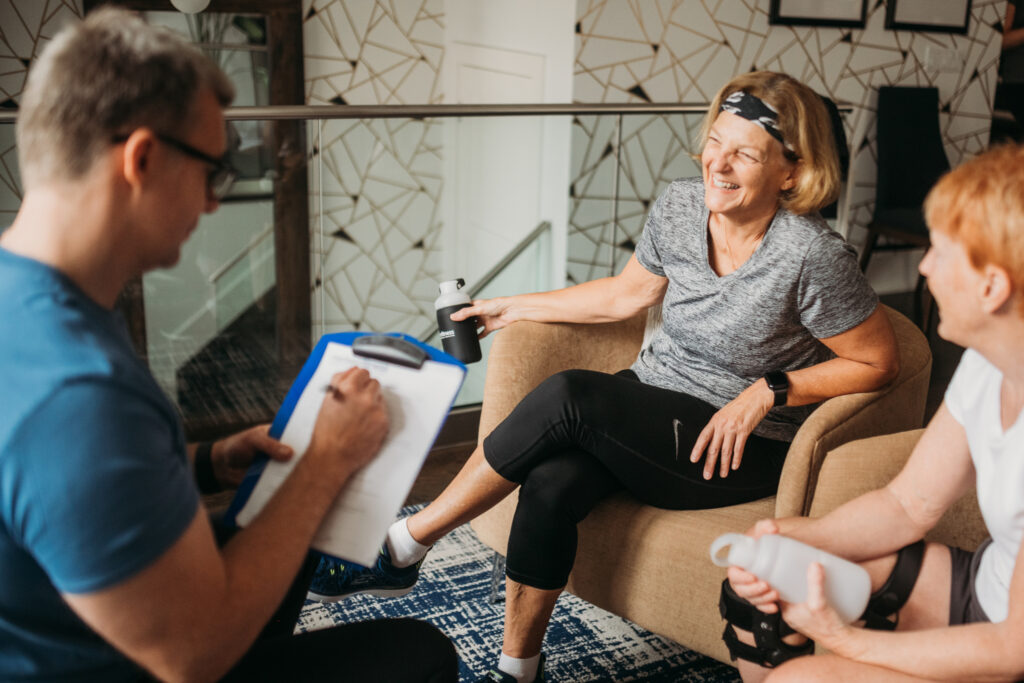
There are many things that set us apart from the competition, but the most important one is our trainers. We select (and further train) only the best of the best. Our team is a kind and dedicated bunch and, most importantly, each member has a strong understanding of exercise physiology, injury prevention and biomechanics. This is how we ensure your workouts are not only effective but safe and smart too. 


Premium in-home personal trainer in Toronto, Collingwood, Hamilton, London, and Ottawa. Personal virtual trainer.

Top Mistakes People Make when Hiring A Pro Trainer

Avoid the Common Pitfalls of Choosing a Professional Trainer with Our Insider Knowledge.

Take the first step towards smarter decisions by knowing which questions to ask. Enter your email to receive your FREE guide.

Premium in-home personal trainer in Toronto, Collingwood, Hamilton, London, and Ottawa. Personal virtual trainer.
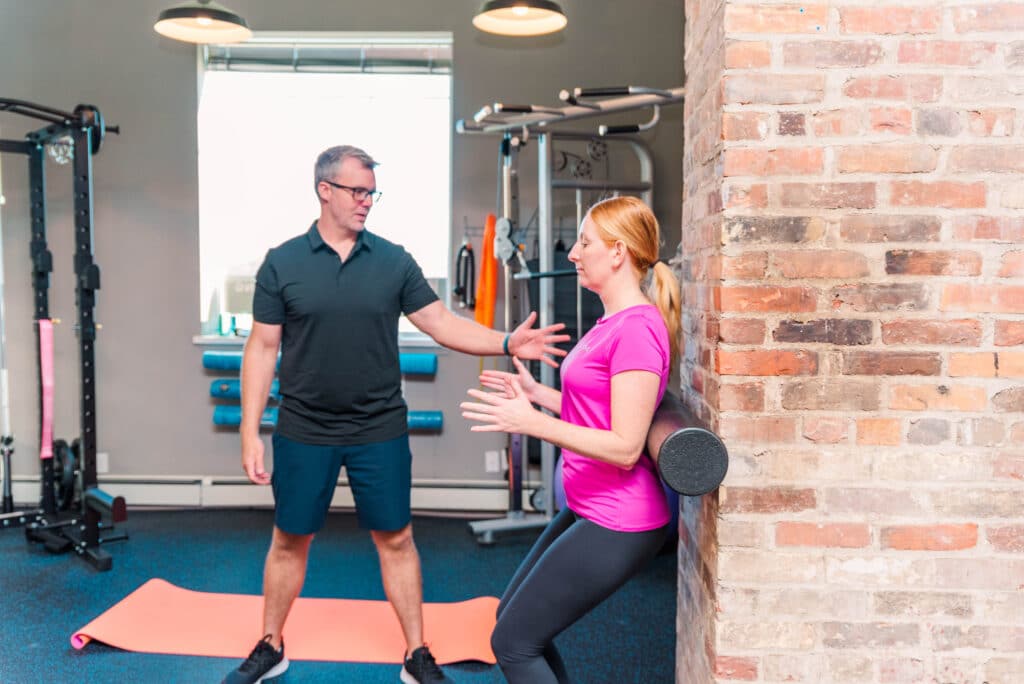
a woman in a black shirt practices balance and coordination with a trainer who knows strength alone isn't enough

Balance After 50: The Skill Your Strength Needs Now

As a team of in-home and virtual personal trainers, we spend a lot of time talking about strength. It builds bone density, protects joints, and keeps clients independent as they age. But over the years, we’ve noticed a gap in how most people approach fitness after 50: they build strong muscles while leaving the nervous system that controls those muscles largely untrained. A client can squat their body weight and still feel unsteady stepping off a curb, catching themselves on uneven grass, or turning quickly when someone calls their name from behind. That gap between strength and control is exactly what this article is about.

We’ve written before about the enormous value of walking: how it supports cardiovascular health, mood, and consistency in a fitness routine (see our posts on why walking delivers powerful results and daily step counts). Walking remains one of the best foundational habits we recommend. But walking forward, on a flat and predictable surface, only trains one narrow slice of how the body actually needs to move through the world. This article is the next layer of that conversation: what happens when movement gets less predictable, and why training for that unpredictability matters more with each passing decade.

STRENGTH IS NECESSARY, BUT IT ISN’T THE WHOLE SYSTEM

Strength training gives muscles the capacity to produce force. It’s essential, and we’re not backing away from it. But force production is only useful if it’s applied at the right moment, in the right direction, with the right timing. That coordination piece is governed by an entirely different system: the sensory and neuromuscular network that senses where your body is in space and reacts to change. Researchers reviewing exercise interventions for older adults have found that “balance and strength training improves postural control, gait stability, and neuromuscular coordination” (Healthcare, 2024): benefits that strength work alone does not fully deliver. In other words, the muscle and the message it receives from the brain are two separate variables, and both need attention.

This is why we see clients who are strong in the gym but still hesitant on stairs, in crowded spaces, or on trails. Their muscles are ready, but their balance and reaction systems haven’t been asked to keep up.

BALANCE IS A SKILL, NOT A TRAIT

One of the most common misconceptions we hear is that balance is something you either have or don’t — a fixed trait tied to age. In reality, balance is trainable, measurable, and responsive to practice, much like any other physical skill. A large systematic review of fall-prevention research concluded that “there is high certainty evidence that exercise reduces falls and that balance and functional exercises plus resistance training… successfully prevent falls” (Age and Ageing, Oxford Academic, 2023). That distinction matters: it’s not resistance training in isolation and it’s not balance work in isolation. It’s the combination that produces results.

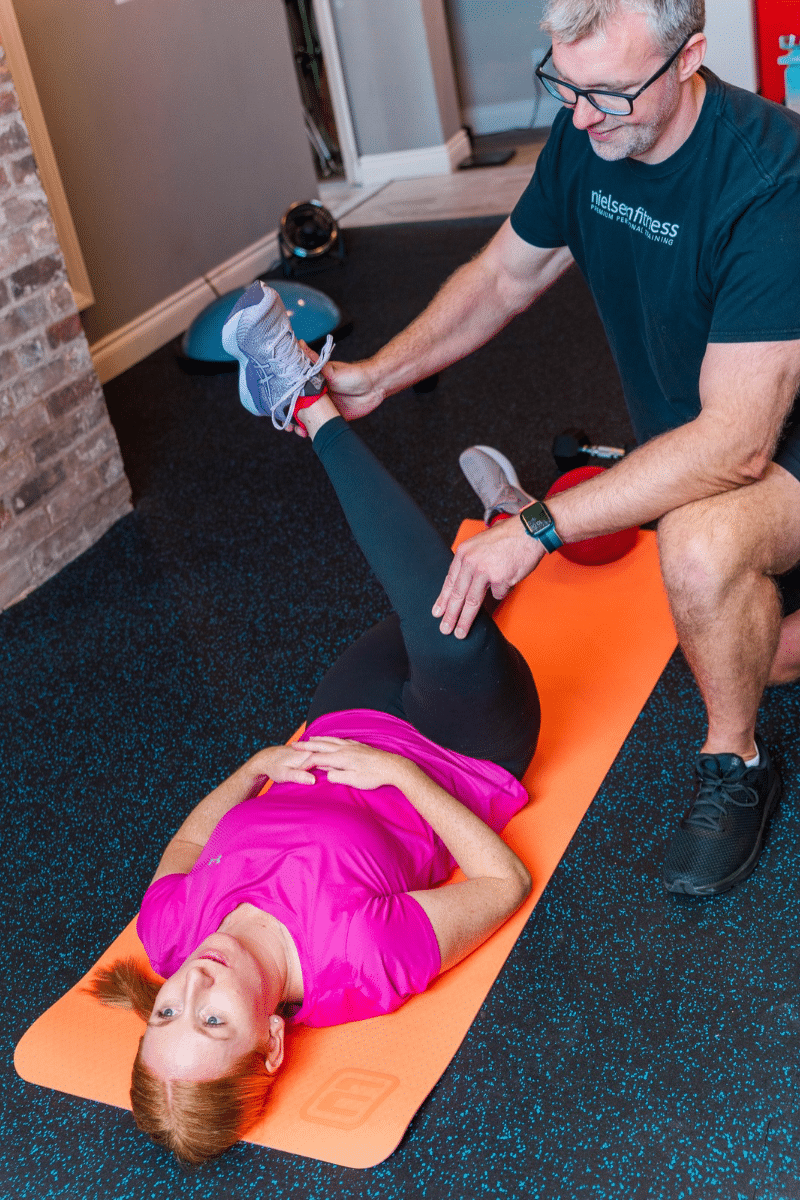
This is where drills like single-leg stands, single-leg reaches, and controlled stability work on an unstable surface come in. These exercises ask the ankle, knee, hip, and core to communicate in real time, correcting small shifts before they become a stumble. We often start clients on simple single-leg holds near a wall or countertop, then progress to reaching drills that add controlled instability: reaching toward the floor, to the side, or behind the body while balancing on one leg.
As that base improves, we’ll layer in an unstable surface like a folded mat or a foam pad, which forces the ankle and foot to make constant micro-adjustments the same way a curb, gravel path, or uneven sidewalk would in real life. Over weeks, most clients notice they no longer need to grab the counter every time they put on a shoe, and stepping onto grass or a soft trail stops feeling like a small hazard.

It’s worth being clear about what single-leg work is actually training. It isn’t about how long someone can hold a pose, but how quickly and smoothly the body corrects a wobble the moment it appears. That correction happens below the level of conscious thought, which is exactly why it needs to be practiced deliberately rather than left to chance.

COORDINATION AND THE VALUE OF CHANGING DIRECTION

Everyday life rarely asks us to move in a straight line for long. We pivot to avoid a shopping cart, step sideways around a pet, turn to check for traffic, or backtrack after realizing we walked into the wrong room. These moments require coordination: the ability to organize multiple muscle groups and joints into a single, fluid movement pattern on short notice.

We train this directly with changes of direction: shuffling laterally, cutting from a forward walk into a backward step, or weaving through a set of cones with quick turns. We’ve also written about how the body moves through different planes of motion in our piece on directional training, and this is where that concept becomes especially practical for clients over 50.

Backward walking and lateral walking, specifically, activate stabilizing muscles around the hip and ankle that forward walking barely touches, while also demanding more conscious spatial awareness since you can’t see where you’re stepping. A review examining mechanisms behind fall risk in older adults noted that “cognitive exercises enhance attention, spatial awareness, [and] decision-making” (Healthcare, 2024) — which is precisely what a change-of-direction drill demands: think, decide, and move, all within a fraction of a second.

REACTION TIME DOESN’T HAVE TO DECLINE THE WAY PEOPLE EXPECT

Reaction time is often treated as an inevitable casualty of aging, but the research tells a more encouraging story. Reactive balance training — drills that intentionally introduce a small, controlled perturbation and ask the body to recover — has shown some of the strongest results of any single intervention studied. A 2025 systematic review of fall-prevention exercise types found that “perturbation-based reactive balance training demonstrated particularly strong effects… with reductions ranging from 50–75%” (Life, 2025), a notably larger effect than standard balance training alone.

In a home or virtual training setting, we recreate this principle in accessible ways: a light, unexpected nudge while a client holds a stance, a partner tossing and catching a ball during a single-leg hold, or a sudden verbal cue to change direction mid-step. These drills train the nervous system to respond quickly and appropriately rather than freezing or overcorrecting: the exact skill that determines whether a stumble becomes a recovered step or a fall.

CONFIDENCE IS THE OUTCOME THAT ACTUALLY CHANGES DAILY LIFE

Every drill described above serves one ultimate purpose: helping clients move through their day without hesitation. Confidence in movement isn’t a soft, secondary benefit — it’s a measurable outcome tied directly to physical function. A systematic review of fall-prevention interventions in frail older adults found that structured exercise programs “significantly reduced the fear of falling and improved physical performance” (ScienceDirect, 2025). Fear of falling is not a minor psychological footnote; it changes how people live, often causing them to avoid activities, shrink their social lives, and move more stiffly and cautiously, which paradoxically increases actual fall risk.

We see this shift constantly with clients. Someone who once avoided uneven sidewalks or hesitated on staircases starts taking those same paths without a second thought after a few months of balance, coordination, and reactive training. That’s not a coincidence. It’s the nervous system relearning that it can trust the body to respond, and that trust tends to ripple outward: clients travel more freely, keep up with grandchildren on uneven playgrounds, and stop mentally scanning every room for something to hold onto.

BRINGING IT TOGETHER IN A SESSION

A well-rounded program for anyone over 50 shouldn’t treat strength, balance, coordination, and reaction time as separate boxes to check. In practice, they overlap constantly: a single-leg deadlift builds strength while demanding balance; a lateral shuffle into a controlled stop builds coordination while training deceleration; a reactive catch-and-balance drill trains reaction time while reinforcing confidence. This is the layer of training that goes beyond walking and beyond the weight room, addressing the parts of daily movement that are unpredictable, quick, and easy to overlook until something goes wrong.

If you’ve been building strength but still feel unsteady on uneven ground, hesitant in crowded spaces, or slower to react than you used to be, that’s a sign your training needs this next layer. Our team of in-home and virtual personal trainers can build a program around balance, coordination, reaction time, and the confidence that comes with all three. Book your first session with Nielsen Fitness and let’s start training the whole system, not just the muscles.

Read More »

FAQs

What makes Nielsen Fitness different from other Toronto personal trainers?

Nielsen Fitness has been one of Toronto’s best personal training companies since 2006. Unlike large gyms or app-based programs, every session is fully customized, delivered one-on-one, and backed by a team with deep expertise in exercise physiology, injury prevention, and biomechanics. We also specialize in working with adults 50+ and those with unique physical needs, which is an area where most trainers have limited experience.

Absolutely! It’s one of our core specializations. Our personal training for seniors + older adults means that we understand how the body changes with age and design programs that build functional strength, improve balance, reduce fall risk, and keep you moving well for years to come. Whether your goal is to manage chronic pain, recover from injury, or simply stay active and independent, we’ve got you covered.

Our online sessions are delivered live via video call, not pre-recorded videos or generic programs. Your trainer is fully present, watching your form, correcting technique, and adjusting the workout in real time. Many of our clients find it just as effective as in-person personal trainers in Toronto, especially with the added convenience of being able to train from anywhere in Canada.

Yes. Our in-home personal training service means you never have to leave your house, condo, or apartment. We bring everything needed for a safe, effective, and fully personalized workout directly to you.