
November 20th, 2026
Testosterone & Mid-Life: What Men Need to Know Now
Testosterone supports muscle, bone density, energy, and mood, and it begins a gradual decline for most men during their thirties and forties. That shift explains why mid-life often brings a thicker waistline, slower recovery, and a dip in drive. Exercise gives men real influence over how this change unfolds, and in-home personal training makes it far easier to apply that influence week after week. This guide covers what happens to testosterone with age, what recent research says about training, and how in-home personal training turns evidence into a routine that fits a busy schedule.
WHAT HAPPENS TO TESTOSTERONE IN MID-LIFE
Testosterone plays a central role in maintaining muscle, bone, libido, and sperm production. When testosterone drifts lower with age, men tend to lose lean mass, store more visceral fat, and recover more slowly from hard sessions. Body fat can deepen the problem, because fat tissue converts testosterone into estrogen, so a larger waistline can push testosterone down further. The result is a cycle in which low energy leads to less training, and less training leads to more fat and less muscle.
Medicine has taken notice. A recent review points out that U.S. testosterone prescriptions rose elevenfold between 2001 and 2011, mostly among middle-aged and older men and without new medical indications, and that some men with low-normal levels consider supplementation an anti-aging strategy.
WHAT RECENT RESEARCH SAYS ABOUT EXERCISE AND TESTOSTERONE
Researchers have compared testosterone treatment with training directly. That same 2024 review concluded that for muscle strength, “an exercise program is likely to be more beneficial than T treatment” (Sports Medicine – Open, 2024). Adding physiological-dose testosterone to training gave no further strength benefit, and testosterone had modest effects on aerobic fitness compared with exercise.
Training also appears to influence the hormones that build tissue. A meta-analysis of 22 randomized trials involving 959 older adults with sarcopenia found resistance training can “improve muscle strength and the level of synthetic hormones” (Archives of Gerontology and Geriatrics, 2024). A single session raises testosterone only briefly, so the payoff comes from consistent training over months.
Combining medical care with training can help as well. In a 52-week randomized trial of 148 men aged 70 and older with low testosterone and mobility problems, neither testosterone therapy nor training alone reduced fatigue compared with controls, yet “only the Combo group experienced reduced fatigue and tiredness” (The Aging Male, 2024). Those men are older than most mid-life readers, but the lesson carries over: when a physician confirms true deficiency and prescribes treatment, structured training still belongs in the plan. That makes in-home personal training a practical way to deliver supervised, progressive resistance work.
TRAINING PRINCIPLES THAT SUPPORT TESTOSTERONE AFTER 40
Heavy compound lifts such as squats, deadlifts, rows, and presses recruit large amounts of muscle and anchor any program built to support testosterone, and in-home personal training suits them well because a trainer can teach each lift safely with simple equipment. Two to three full-body sessions per week suit most men in mid-life, with weights that rise gradually as technique allows. The Nielsen Fitness guide on how often to strength train after 50 explains how the right frequency depends on experience, goals, and recovery capacity.
Recovery deserves equal attention, because high training frequency without adequate rest can lower testosterone instead of raising it. Seven or more hours of sleep, enough protein, and planned lighter weeks keep the hormonal environment favourable. The post on signs your program needs more recovery lists the warning signs that call for dialing back. Body composition matters too. Resistance training reduces visceral fat, which limits the conversion of testosterone to estrogen and supports healthier testosterone levels over time. A trainer providing in-home personal training can also track sleep, soreness, and energy, then adjust the week’s workload.
Blood work comes first when symptoms such as persistent fatigue, low libido, or unexplained muscle loss appear. A physician can confirm whether testosterone is clinically low, and training should continue alongside any treatment. Many men share those results with their trainer so in-home personal training reflects their health history.
WHY IN-HOME PERSONAL TRAINING FITS MID-LIFE SCHEDULES
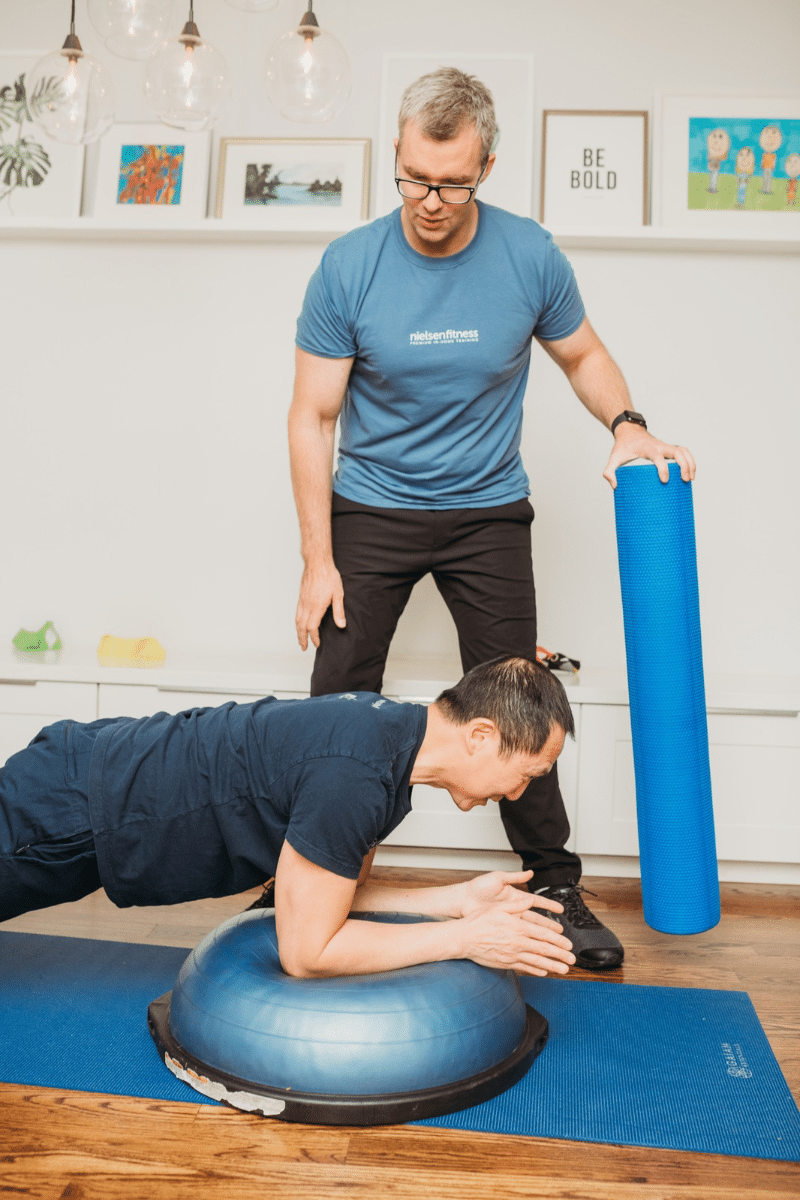
Consistency decides whether any testosterone-supporting program works, and in-home personal training removes the most common obstacles to consistency. There is no commute, no waiting for equipment, and no crowded gym floor. A trainer arrives with a plan, adjusts it to the space and equipment in a home or condo gym, and watches technique closely, which matters when joints and backs are less forgiving than they were at 25. Nielsen Fitness has delivered in-home personal training in Toronto since 2006, and the team’s post on in-home personal training versus the gym after 50 compares the two options on convenience, accountability, and privacy.
Accountability is the other advantage. A scheduled appointment at your door is harder to skip than a gym membership, and in-home personal training builds progress tracking into the routine through regular assessments of strength and function. Those numbers show improvement before the mirror does, which keeps motivation steady.
BUILDING A MID-LIFE PLAN THAT LASTS
A sound plan has four parts: structured strength training, enough recovery, attention to sleep and nutrition, and a physician’s input when symptoms warrant it. In-home personal training ties those parts together by putting a qualified professional in charge of progression, so loads rise at a pace the body can absorb. Men who start in-home personal training now give their testosterone, muscle, and metabolic health the best chance of holding steady through their fifties and sixties.
Testosterone will keep shifting with age, yet the research points in a consistent direction: train with purpose, recover well, and treat medical therapy as a decision for a doctor rather than a shortcut around effort, with in-home personal training keeping that effort consistent.
START STRONG WITH IN-HOME PERSONAL TRAINING
Nielsen Fitness brings experienced trainers to your home in Toronto, the GTA, Collingwood, and Ottawa, with virtual personal training available anywhere. Contact Nielsen Fitness to request a free first workout and start building an in-home personal training plan around your goals, schedule, and health history.