
In Home Training Older Adult Exercises Trainer
Strength training after 50 pays off in independence, balance, bone health, and confidence. Where you train has a lot to do with whether you keep showing up. A gym and in-home personal training can both deliver real results, but they work very differently. In this post, we’ll cover how in-home personal training compares with the gym on convenience, accountability, privacy, personalization, and equipment.
THE TIME IN-HOME PERSONAL TRAINING GIVES BACK
The gym asks for plenty before your first rep: packing a bag, driving, parking, waiting for a machine, and driving home again. A thirty-minute workout can swallow two hours. With in-home personal training, the workout comes to you, and the commute is measured in steps rather than kilometres. That matters in a Canadian winter, and it matters if you are managing a stiff knee or a full caregiving schedule. Consistency drives results, and removing friction is the most reliable way to protect it. Our in-home personal training team has watched people who drifted away from gym memberships for years settle into two dependable sessions a week once the travel disappeared.
WHY IN-HOME PERSONAL TRAINING KEEPS YOU ON TRACK
A gym membership gives you access, not accountability. Nobody notices when you skip a week. A systematic review of unsupervised home-based exercise for older adults found “little impact on lower extremity functions in older adults” (BMC Geriatrics, 2024). The authors also noted high variability between studies, so this is a caution rather than a verdict. It does match what we see in practice: training alone, without structure or feedback, tends to fall short. In-home personal training closes that gap with a scheduled appointment and a qualified coach in your living room. Your trainer notices when your squat gets shallower, lowers the load when you are worn out, and adds challenge when you are ready. A solo gym visit rarely provides that kind of feedback.
PRIVACY: IN-HOME PERSONAL TRAINING WITHOUT AN AUDIENCE
Plenty of adults over 50 feel self-conscious in a busy weight room. That is especially true when starting from scratch, returning from an injury, or learning an unfamiliar exercise. At home, no one watches you adjust a weight, take an extra minute of rest, or repeat a movement until it feels right. In-home personal training also makes it easier to speak openly about the details that shape a safe program, such as an old surgery, balance worries, or pain that flares on the stairs. Those conversations go better in your own kitchen than between cable machines. Privacy lets people train honestly, and honest training is safer and more effective.
HOW IN-HOME PERSONAL TRAINING FITS YOUR LIFE
A gym is designed for the average member, while in-home personal training is designed around you. A trainer who sees your stairs, your chairs, and the way you rise from the couch can build a program around the movements your life demands: lifting groceries, climbing steps, getting off the floor, and carrying luggage. Exercise selection, range of motion, tempo, and load can shift week to week as your joints, energy, and goals change.
The gym has real strengths too. A 2024 meta-analysis concluded that “significant strength and functional performance outcomes are attainable” (Journal of Functional Morphology and Kinesiology, 2024) with uncomplicated, machine-based training. Machines are a legitimate tool, and the variety of a well-equipped gym suits some people very well. What matters is whether you will use them consistently and whether someone is checking your technique.
EFFECTIVE IN-HOME PERSONAL TRAINING DOES NOT NEED A FULL HOME GYM
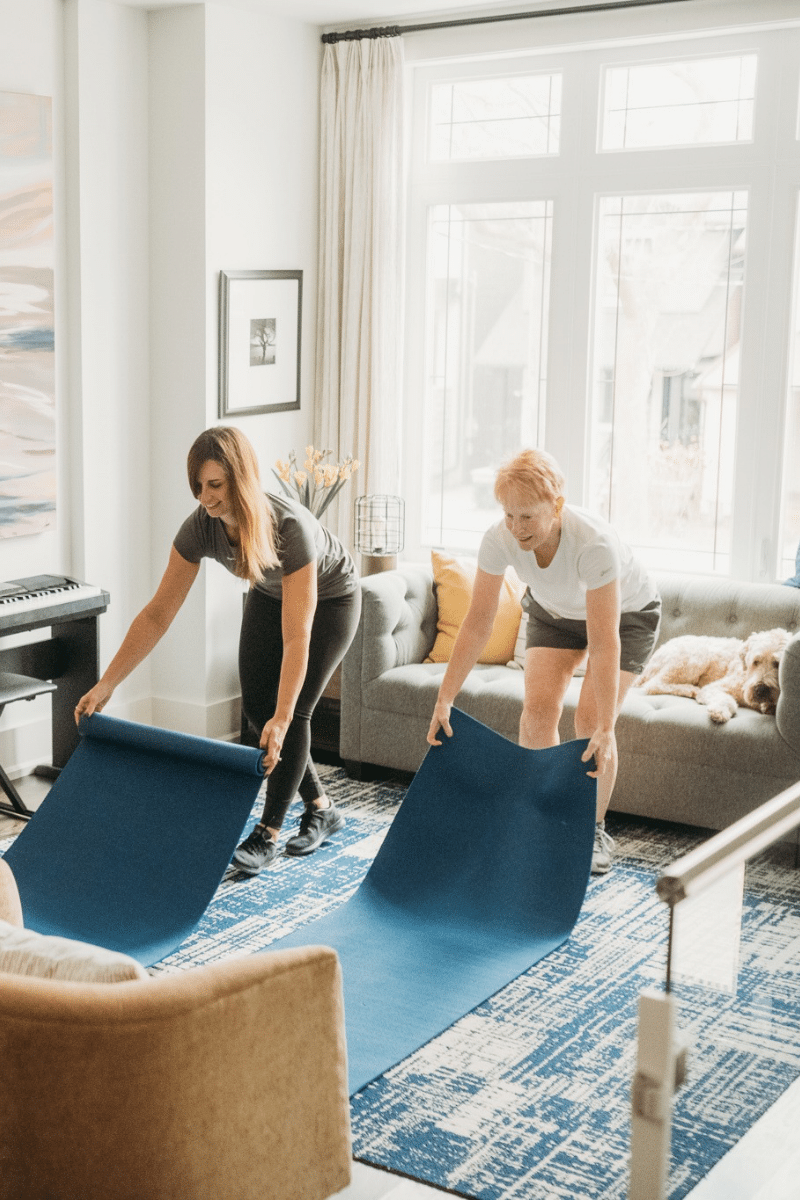
The most persistent myth about training at home is that it takes a garage full of equipment. This could not be further from the truth! A well-designed in-home personal training program might rely on a pair of adjustable dumbbells, a resistance band, a sturdy chair, and a mat. Progress comes from slower tempo, pauses, deeper range of motion, single-leg variations, and harder leverages rather than from a rack of plates. We explain how in our post on progressing bodyweight exercises without adding weight. Our comparison of machines and free weights for the best home workout covers the trade-offs of adding equipment. Strength responds to challenge, not square footage, and building muscle after 50 is very practical at home.
WHICH IS RIGHT FOR YOU
The gym tends to suit people who are self-motivated, confident with technique, and happy to spend time travelling. In-home personal training tends to suit people who value convenience, privacy, and coaching built around their space. It works especially well for adults who are new to lifting, returning from injury, or managing joint pain. Many people combine the two, using in-home personal training to learn and progress and a gym for variety. Whatever the mix, the best option is the one you will keep doing for years. Strength after 50 is built across seasons rather than weeks, a point we explore in why strength training matters more after 40 and in our post on progressive loading for strong bones after 50.
HOW NIELSEN FITNESS BRINGS IN-HOME PERSONAL TRAINING TO YOU
In-home personal training has been our specialty since 2006. Our certified trainers come to your home or condo in Toronto, Collingwood, Hamilton, London, and Ottawa. Our virtual personal training delivers the same coaching to any space with a Wi-Fi connection. Our team focuses on adults 50+ and on people with special needs such as chronic pain, so in-home personal training sessions with us account for joint sensitivity, balance, and recovery from day one. Every program starts with a conversation about your goals, history, and home setup. From there we build with what you already own and add equipment only when it earns its place. If you prefer to train outside the home, our private studios in Toronto and Collingwood offer another option. You can learn more about in-home personal training in Toronto or our virtual personal training service.
GET STARTED WITH IN-HOME PERSONAL TRAINING
If in-home personal training sounds like the right fit, we would love to talk. Contact our team to discuss your goals and see how in-home personal training or virtual sessions can fit your home and your schedule!