
Functional Strength Older Adult Exercises Trainer
At Nielsen Fitness, we hear the same doubt all the time: “Isn’t it too late for me to build muscle?” Our answer is always the same, and it’s backed by decades of combined coaching experience and a growing body of exercise science: no, it is not too late. In fact, building muscle after 50 may be one of the most powerful things you can do for your long-term health, independence, and quality of life. As a team of in-home and virtual personal trainers, we’ve helped clients in their 50s, 60s, 70s, and beyond gain real, measurable strength. This post breaks down exactly why muscle-building works at any age and how our in-home personal training approach makes it achievable, sustainable, and even enjoyable.
THE SCIENCE BEHIND MUSCLE GROWTH AFTER 50
It’s true that our bodies naturally lose muscle mass as we age. According to Harvard Health Publishing, sarcopenia, the medical term for age-related muscle loss, can begin around age 35 and typically progresses at 1 to 2 percent a year, accelerating to roughly 3 percent a year after 60, and adults who skip regular strength training can lose four to six pounds of muscle per decade. But here’s the encouraging part: muscle tissue remains remarkably responsive to the right stimulus at any age. Researchers at the National Institute on Aging have found that resistance training can help prevent frailty and improve mobility and independence in older adults, even those who start later in life.
Muscle doesn’t know your birthday. It only knows whether it’s being challenged. That’s the foundation of everything we do with our clients, and it’s why in-home personal training focused on smart, progressive resistance work can reverse age-related decline rather than simply slow it down.
PROTEIN AND NUTRITION: FUELING THE REBUILD
You cannot build muscle in a nutritional vacuum. This becomes even more true after 50. Harvard Health notes that sarcopenia affects nearly half of adults over 80, and because building muscle requires protein, older adults aiming to increase muscle mass need more protein than they may have needed in their younger years.
As we age, our bodies also become less efficient at using dietary protein to build and repair tissue. This is a phenomenon that researchers call anabolic resistance. The solution isn’t complicated, but it does require intention.
Most of our clients need more protein than they think, often spread evenly across meals rather than loaded into a single dinner. We typically guide clients toward lean sources like chicken, fish, eggs, Greek yogurt, legumes, and quality protein supplements when whole food intake falls short. Alongside protein, adequate overall calories, hydration, and micronutrients like vitamin D and calcium support both muscle repair and bone health, which becomes increasingly important as we age.
If desired, our in-home and virtual personal trainers can regularly review nutrition habits with clients, not to prescribe restrictive diets, but to make sure the fuel is there to support the muscle you’re working so hard to build.
RECOVERY AND SLEEP: WHERE THE REAL GROWTH HAPPENS
It’s important to remember that muscle isn’t actually built during your workout. It’s built during recovery. This is especially critical after 50, when recovery windows tend to be longer and joints, tendons, and connective tissue need more careful attention.
Sleep is the single most powerful recovery tool available, and it’s free. The Sleep Foundation reports that during sleep the body works to repair cells and tissue, supporting the muscle recovery process athletes and everyday exercisers rely on. Mass General Brigham adds that the body does the bulk of this repair work during deep sleep, and that without enough time in that stage, muscles may not get the recovery needed to perform at the same level the next day.
Chronic sleep deprivation blunts these gains and can increase injury risk. Beyond sleep, we coach clients on active recovery, proper hydration, and listening to the body’s signals rather than pushing through pain. This is one of the biggest advantages of in-home personal training: your trainer sees how you move, sit, and recover in your own environment, allowing for real-time adjustments that generic gym programs simply can’t offer.
PROGRESSIVE OVERLOAD: THE NON-NEGOTIABLE PRINCIPLE
If there’s one principle that separates real muscle-building from spinning your wheels, it’s progressive overload. This simply means gradually increasing the demand placed on your muscles over time, whether through heavier weight, more repetitions, slower tempo, or reduced rest periods. Without this gradual challenge, muscles have no reason to adapt or grow.
The key after 50 is applying progressive overload safely, with attention to joint health, form, and recovery capacity. This is precisely where a knowledgeable coach makes all the difference. Harvard Health has reported on research reviewing dozens of studies of men in their 50s through 80s, finding meaningful gains in lean body mass through progressive resistance training.
Our in-home and virtual personal trainers design programs that push clients just enough to stimulate growth without inviting injury, adjusting week to week based on how the body responds. Progressive overload doesn’t mean lifting recklessly heavy weights. It means consistent, intelligent progression tailored to you.
TRAINING FREQUENCY: CONSISTENCY OVER INTENSITY
A common misconception is that building muscle after 50 requires daily, grueling workouts. In reality, most clients see excellent results training each major muscle group two to three times per week, with adequate rest between sessions. This frequency allows for enough stimulus to drive growth while respecting the body’s need for recovery.
Consistency matters far more than occasional heroic efforts. A well-structured routine performed reliably, whether in your living room with an in-home personal trainer or through a virtual session from your home office, will outperform sporadic intense workouts every time. We build training schedules around your real life, not an idealized version of it, because sustainable frequency is what actually produces results over months and years.
MEASURING PROGRESS: BEYOND THE SCALE
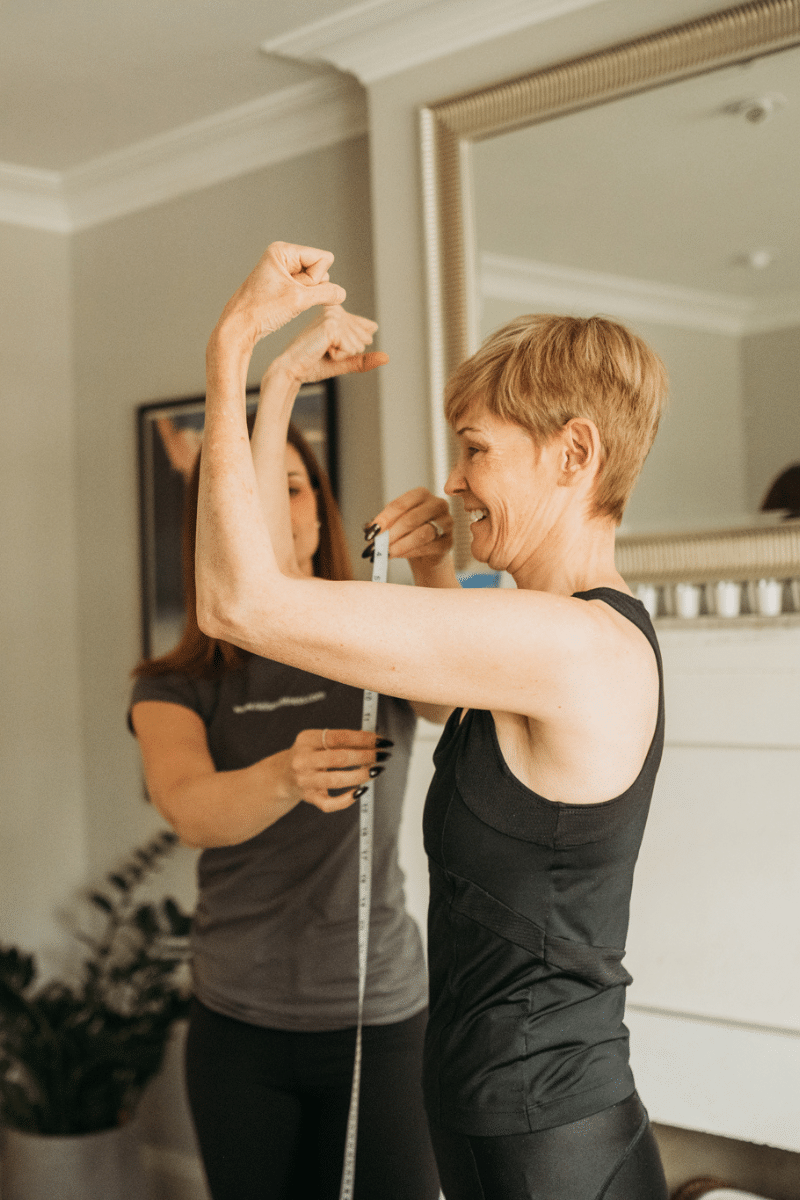
Muscle-building progress isn’t always visible on a bathroom scale, and relying on weight alone can be discouraging and misleading. Instead, we track strength gains, such as the amount of weight lifted or repetitions completed, along with functional markers like how easily a client climbs stairs, rises from a chair, or carries groceries.
Body composition adaptations, improved posture, and better sleep quality are all signs that muscle-building efforts are working. Our trainers check in regularly to track these markers, celebrate small wins, and adjust programs as needed. Progress after 50 is often steadier and more sustainable than in younger years, and recognizing it in all its forms keeps clients motivated for the long haul.
IT’S NEVER TOO LATE TO GET STRONGER
Perhaps the most important message we share with every new client is this: your current age is not a barrier to building real, lasting strength. Susan Ratay, DO, a family physician at University Hospitals, has said that resistance training is the most effective type of physical activity for preventing or delaying sarcopenia in adults of any age. We’ve watched clients in their 60s deadlift for the first time in their lives. We’ve seen clients in their 70s regain the ability to get up off the floor without assistance. Muscle responds to effort and consistency, not to the number of candles on your last birthday cake. With the right program, proper nutrition, adequate recovery, and a trainer who understands the nuances of training after 50, remarkable transformations are not just possible, they’re common.
READY TO BUILD MUSCLE AT ANY AGE?
If you’re ready to experience what personalized, expert-guided in-home personal training can do for your strength, mobility, and confidence, the Nielsen Fitness team is here for you. Book your free consultation today and let’s build a plan designed around your body, your goals, and your life.