
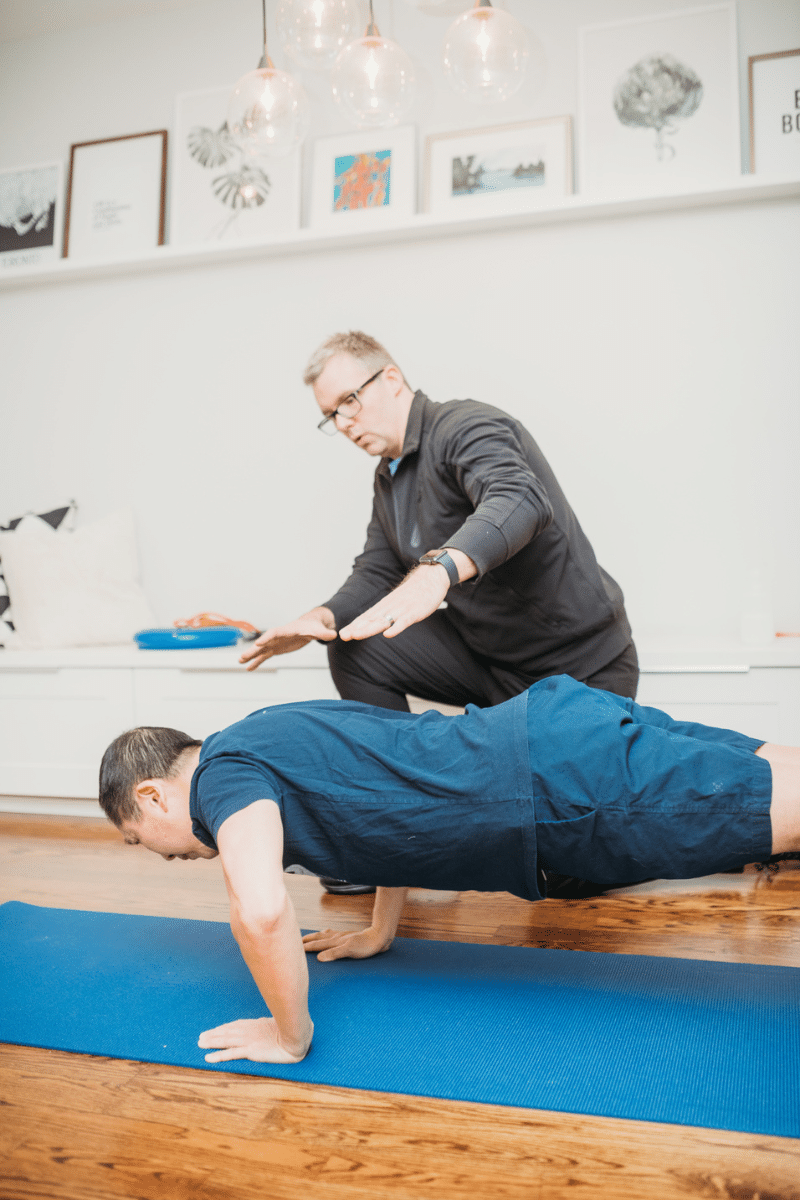
Functional Strength In Home Training
As a team of in-home and virtual personal trainers, we hear a version of the same concern from many clients: if they don’t have dumbbells or machines at home, they worry their progress will stall. It’s a natural assumption, but it isn’t how muscles actually work.
Bodyweight training doesn’t plateau because your body runs out of resistance to offer. It plateaus when the exercise itself stops being challenging enough to demand adaptation.
In reality, you can make almost any bodyweight movement significantly harder using a handful of simple, research-backed principles: slowing down the eccentric phase, generating more power on the concentric phase, adding pauses, changing your hand or foot position, and increasing your range of motion.
Below, we break down exactly how to apply these principles.
THE PUSH-UP AS A MODEL FOR BODYWEIGHT TRAINING PROGRESSION
The push-up is the perfect example because it’s one of the most scalable exercises in bodyweight training.
Let’s start with the eccentric (lowering) phase. Instead of dropping to the floor in one second, try taking four or five seconds to lower yourself down. This isn’t just a coaching preference. A 2025 study on squat tempo found that a slower eccentric tempo may optimize hypertrophy (increasing muscle mass and size of muscle fibres) compared to a faster lowering phase (Frontiers in Physiology, 2025), and the same logic transfers directly to a slow, controlled push-up descent.
Once you’ve mastered a slow descent, shift your attention to the concentric (pushing) phase. Rather than pressing up at a normal pace, try to push yourself up as explosively as possible. If you’re an advanced trainee, maybe even work toward a clap push-up where your hands leave the ground entirely. Forceful concentric contractions are directly responsible for explosive power and acceleration, a quality that a slow, controlled rep alone won’t build.
Next, add a pause. Holding yourself an inch or two above the floor for two or three seconds removes any momentum from the equation and forces your stabilizing muscles to work overtime. Old-school lifters swore by paused reps because they eliminate the stretch reflex, the elastic “bounce” that normally helps you out of the bottom of a rep.
Finally, experiment with hand position and range of motion. Push-ups performed with hands in a narrow position will increase activation in the chest and triceps, while a wider hand position shifts more emphasis onto the lower portion of the chest. Depending on your individual strengths, difficulty in each hand position will vary. On the range of motion side, elevating your feet increases the demand on your shoulders and chest.
None of these variations require a single added pound, yet each one meaningfully increases the difficulty of the movement.
APPLYING THE SAME PRINCIPLES TO LUNGES
Lunges respond beautifully to these same five levers. A standard lunge becomes far more demanding when you slow the descent into the bottom position, spending three to five seconds lowering your back knee toward the ground, which extends time under tension in exactly the way the eccentric research above describes.
From there, you can drive up out of the lunge as quickly and powerfully as you can, which builds the kind of explosive strength that carries over to running, jumping, and changing direction. Add a one or two second pause at the bottom of the lunge, right when your back knee hovers just above the floor, and you’ll immediately feel how much harder the stabilizing muscles around your hip and knee have to work once momentum is taken out of the equation.
Altering your stance also changes the challenge entirely. A reverse lunge shifts more load to your glutes and hamstrings, while a walking lunge adds a dynamic, balance-based component.
To increase the range of motion, try elevating your front foot on a low step, which deepens the movement and demands more from your quads and glutes at end range. This lines up with findings that full range of motion training is more effective than partial range of motion for maximizing muscle strength and hypertrophy in the lower body (Scandinavian Journal of Medicine & Science in Sports, 2021).
SQUATS, STEP-UPS, WALL SITS, AND STAIR EXERCISES
Squats follow the exact same blueprint. Slow the eccentric phase down to a count of four or five, then explode upward out of the bottom position, even adding a small jump if your joints tolerate it well. A three second pause at the bottom of a squat, sometimes called a dead-stop squat, removes the stretch reflex that normally helps you rebound out of the hole, making the movement noticeably harder even though the load hasn’t changed. Widening or narrowing your stance shifts emphasis between your inner thighs and outer glutes, and standing on an elevated surface with your heels hanging off the edge increases your range of motion and ankle demand.
Step-ups benefit from the same slow-down-then-explode approach: lower back down from the step with control, then drive up through the working leg as powerfully as possible. Pausing halfway up, with your knee bent at ninety degrees, adds a serious stability challenge, and choosing a taller step or box automatically increases the range of motion and the strength required to complete the movement.
Wall sits are a bit different since they’re a static hold rather than a repetition-based movement, but the same principle of increasing time under tension still applies. Progression in isometric leg training doesn’t happen by adding dynamic repetitions, but by increasing time under tension or adjusting the joint angle (Runlovers, 2026).
Walking your feet slightly farther from the wall deepens the knee angle and range of motion, and holding one leg out straight in front of you turns a basic wall sit into a serious single-leg stability and strength challenge.
Stair exercises, whether you’re doing stair sprints, single-leg step-ups on a staircase, or lateral stair steps, become harder the moment you slow the lowering phase between steps, add an explosive push off each step, pause mid-stride, or take the stairs two at a time to increase your range of motion.
WHY THOUGHTFUL BODYWEIGHT TRAINING PROGRESSION BEATS SIMPLY ADDING WEIGHT
Strength training isn’t really about how much weight you can pile onto a bar. It’s about how intelligently you can apply stress to your muscles and joints so they’re forced to adapt. Bodyweight training gives you an enormous amount of room to do exactly that, through tempo changes, pauses, explosive power, positional shifts, and range of motion adjustments.
The research on eccentric tempo, concentric power, pause reps, hand and foot positioning, and range of motion all points the same direction: variables other than added load can meaningfully change how hard a movement is and what it does to your body.
If you’re ready to see how far bodyweight training can actually take you, we’d love to help. Reach out to Nielsen Fitness today, whether you want in-home coaching or virtual sessions, and let’s build a program that proves you don’t need a single dumbbell to get stronger.