
Months of lifting. Zero progress. One bad rep away from an injury — that’s where many of our new personal training clients start. Nine times out of ten, the problem isn’t effort. It’s that nobody ever checked the fundamentals before handing them a program.
Great personal training isn’t about memorizing more exercises. It’s about knowing which ones actually belong in your program, and why. Below is the checklist our personal training team runs through with every new client, whether we’re in your living room or coaching you through a screen.
1. SCREEN MOVEMENT PATTERNS FIRST
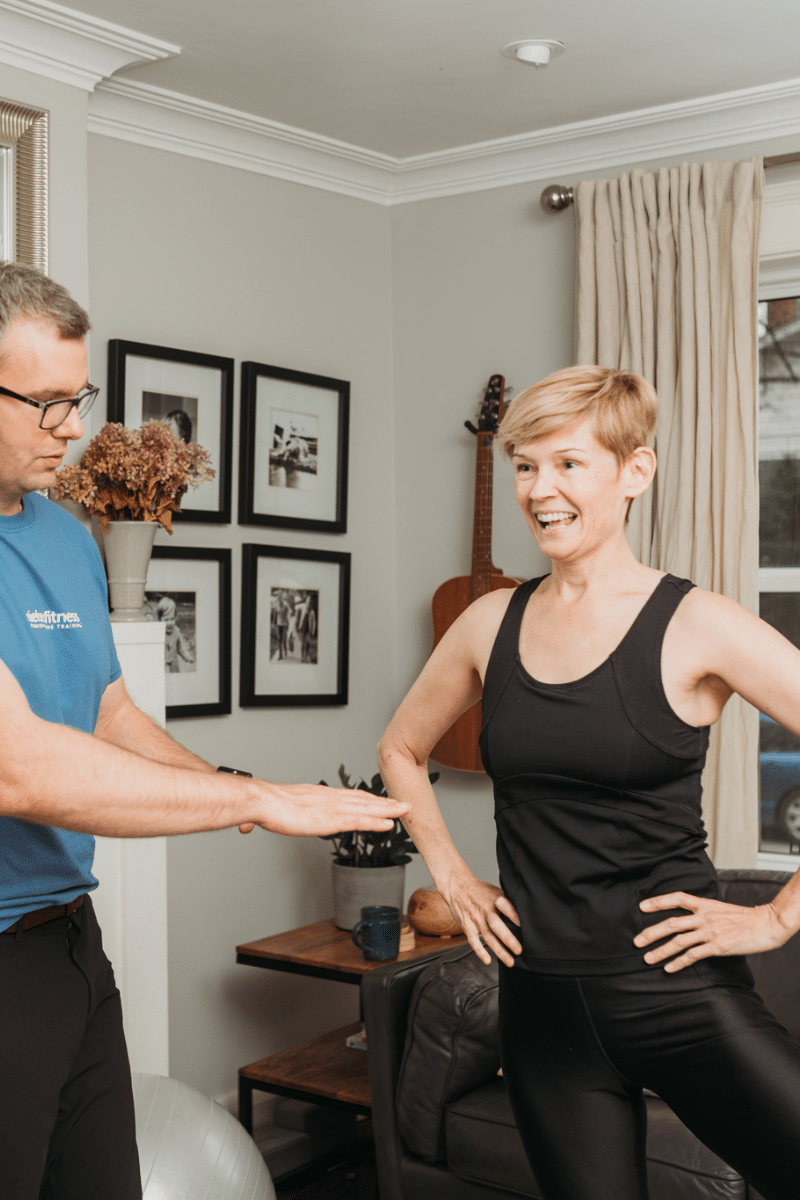
Before we ever load a barbell or hand you a dumbbell, we watch you move. A movement screen during a personal training session looks at how your body squats, hinges, pushes, pulls, and rotates without any added resistance. This tells a trainer far more than a fitness questionnaire ever could, because it shows what your body actually does, not just what you think it does.
Skipping this step is one of the most common personal training mistakes we see, whether it happens at a big-box gym or in a self-guided program. Choosing exercises before you understand someone’s movement quality is like prescribing medication before running any tests. It might work. It also might make things worse.
2. IDENTIFY RESTRICTIONS AND WEAKNESSES EARLY
A movement screen is only useful if someone knows what to look for. During assessments, our personal trainers are watching for specific compensations: a knee that caves in during a squat, a heel that lifts during a lunge, a shoulder that shrugs instead of rotating during an overhead reach. Each of these is a clue pointing to a tight muscle, a weak stabilizer, or a joint that isn’t moving the way it should.
Personal training assessments matter because they help us “identify which muscles need to be stretched or strengthened” (ACE Fitness, 2025). That single insight shapes everything that follows: exercise selection, loading, tempo, even the order of your workout.
3. NEVER SKIP THE WARM-UP
It’s tempting to walk in, grab the heaviest weight on the rack, and go. It’s also one of the fastest ways to get hurt. A proper warm-up raises the temperature of the muscles you’re about to train, increases blood flow to the joints involved, and rehearses the movement pattern at low intensity before you add real load.
Recent fitness reporting has flagged this as a leading culprit behind stalled progress and nagging injuries, noting that “skipping your warm-up is a non-negotiable mistake that can seriously undermine your training efforts” (Rolling Out, 2025). A five to ten-minute warm-up targeted at the specific muscles and joints you’re about to use is not optional.
4. MATCH THE WARM-UP TO THE SESSION
A generic five-minute jog doesn’t prepare your hips for heavy squats any more than arm circles prepare your shoulders for an overhead press. An effective personal training session tailors the warm-up to the day’s movement pattern. Lower-body sessions call for hip openers, glute activation, and ankle mobility work. Upper-body pressing days call for shoulder and thoracic spine mobility. The goal is always the same: wake up the exact muscles and joints that are about to do the work.
5. FIT TECHNIQUE TO THE BODY, NOT THE BODY TO A TEXTBOOK
It’s important to remember that there is no single correct way to squat, hinge, or press. Textbook cues are a starting point, not a rulebook. Your femur length, torso proportions, ankle mobility, shoulder structure, and injury history all influence what safe, effective technique looks like for you specifically.
Two people can do a textbook perfect squat and look completely different, because their proportions are different. Forcing a client with long femurs into a narrow, upright stance because that’s what a diagram shows is a recipe for knee and lower back strain. Recent research on individualized exercise design echoes this directly, with participants describing the need for programs tailored “to their physical body makeup and their age” (International Journal of Environmental Research and Public Health, 2025). Good personal trainers coach the person in front of them, not the diagram in the textbook.
6. ACCOUNT FOR INJURY HISTORY IN EVERY EXERCISE CHOICE
A past shoulder dislocation, a herniated disc, or an old knee surgery doesn’t disqualify someone from strength training. However, it does mean certain exercises, ranges of motion, or loading strategies need to be adjusted or substituted. This is one of the biggest reasons DIY programs pulled from the internet fall short: they can’t account for what your body has already been through. Effective personal training builds your injury history into exercise selection from day one, not after something flares up.
7. LET THE ASSESSMENT DRIVE THE PROGRAM, NOT THE OTHER WAY AROUND
The single biggest mistake underlying all the others is choosing exercises first and assessing later, if at all. Assessment, warm-up, and technique aren’t separate boxes to check. They’re one continuous process that should shape every set you perform. When personal training starts with a real assessment, the exercises that follow actually fit the person doing them.
KEEP READING: PROGRESSION, RECOVERY, AND REST
Getting the fundamentals right is only half the picture. Once your movement patterns, warm-up, and technique are dialed in, the next question is how to keep progressing safely over weeks and months, especially for demanding lower-body work. Our companion post, (Unlock Your Best Workout: Strength, Progress and Confidence), breaks down how progression, recovery, and rest work together in our personal training programs. We recommend reading both posts together for the full picture.
READY TO SEE WHERE YOU STAND?
You don’t have to guess whether your form, warm-up, or program actually fits your body. Book a free assessment and mini workout with Nielsen Fitness and our personal training team will show you exactly what your movement patterns say and what to do about it.