
Aging Functional Strength Injury Prevention
September 18th, 2026
Strong Bones After 50: Why Progressive Loading Matters
Strong bones after 50 is a priority for in-home and virtual personal trainers at Nielsen Fitness. Many clients want to know if lifting weights is safe for their joints, whether walking is enough, and what actually keeps bones after 50 strong as the decades add up. The short answer is that bone is a living tissue that responds directly to the forces placed on it, and one of the most compelling illustrations of that principle didn’t happen in a gym at all. It happened 250 miles above the Earth, aboard the International Space Station.
BONE IS NOT A STATIC SKELETON, BUT A LIVING, ADAPTING TISSUE
It’s easy to think of strong bones after 50 the way we think of the frame of a house: built once, then simply maintained. In reality, bone tissue is constantly being broken down and rebuilt throughout life, a process governed largely by the mechanical stress it experiences. When bone is loaded, specialized cells called osteoblasts respond by laying down new bone matrix. When that loading disappears, the opposite happens: bone-resorbing cells outpace bone-building ones, and density declines.
This is sometimes called Wolff’s Law: the principle that bone remodels itself in response to the demands placed on it. It’s why a tennis player’s dominant arm often has noticeably higher bone density than the other, and it’s why prolonged bed rest, immobilization, or a sedentary lifestyle can quietly erode skeletal strength over months and years. Building strong bones after 50 is crucial: bone density naturally declines with age, and for women, the drop accelerates around menopause as estrogen (which helps regulate bone turnover) declines. The good news is that this same remodeling system that allows bone to weaken is the system that allows it to adapt and strengthen again, provided it receives an adequate mechanical signal.
THE NASA EXPERIMENT NOBODY PLANNED ON EARTH
Few environments strip mechanical loading from the human body as completely as space. In microgravity, astronauts no longer bear their own body weight with every step, causing the skeleton to lose bone mineral density remarkably fast, particularly in the hips and spine. This made long-duration spaceflight an unplanned laboratory for understanding how much mechanical loading is actually needed to build strong bones after 50.
In a study published in 2012, researchers examined bone outcomes in astronauts on missions to the International Space Station, comparing two generations of onboard exercise equipment. The earlier device, the interim resistive exercise device (iRED), allowed astronauts to load up to about 297 pounds of force. According to the study, this device “provided little protection of bone or no greater protection than aerobic exercise” (Journal of Bone and Mineral Research), meaning astronauts using it still experienced substantial bone loss over the course of their missions, despite exercising regularly.
Then, in 2008, NASA introduced the Advanced Resistive Exercise Device (ARED): a piston-based system that used vacuum cylinders to simulate free-weight exercises like squats, deadlifts, and heel raises. ARED allowed loads of up to roughly 600 pounds of force: more than double what the earlier device permitted. When the researchers compared crewmembers who had access to ARED against those who had only used the older iRED, the ARED group showed meaningfully better preservation of bone. This finding held up alongside attention to dietary intake, since adequate nutrition and vitamin D status were also tracked as part of the astronauts’ countermeasure program. In other words, heavier, more mechanically demanding loading was associated with dramatically better outcomes than lighter exercise alone.
This is a fantastic example for how to build strong bones after 50 because it removes so many variables. These weren’t sedentary people; astronauts exercised on a rigorous schedule regardless of which device they were assigned. The difference wasn’t whether they trained, but how much mechanical load their training actually delivered to bone. When the stimulus was too light, the skeleton kept deteriorating despite the effort. When the stimulus was heavy enough, bone had a genuine reason to hold onto (and in some cases rebuild) its density.
BACK ON EARTH: THE LIFTMOR TRIAL AND THE POWER OF SUPERVISION
You don’t need to be launching into orbit to start building strong bones after 50. One of the most important studies in postmenopausal bone health, known as the LIFTMOR trial (Journal of Bone and Mineral Research, 2018), tested a supervised program of high-intensity resistance and impact training in women with low bone mass. Over eight months, women who performed twice-weekly, closely supervised sessions of heavy resistance training increased lumbar spine bone mineral density by about 2.9%, while a comparison group doing a low-intensity program actually lost about 1.2% in the same period.
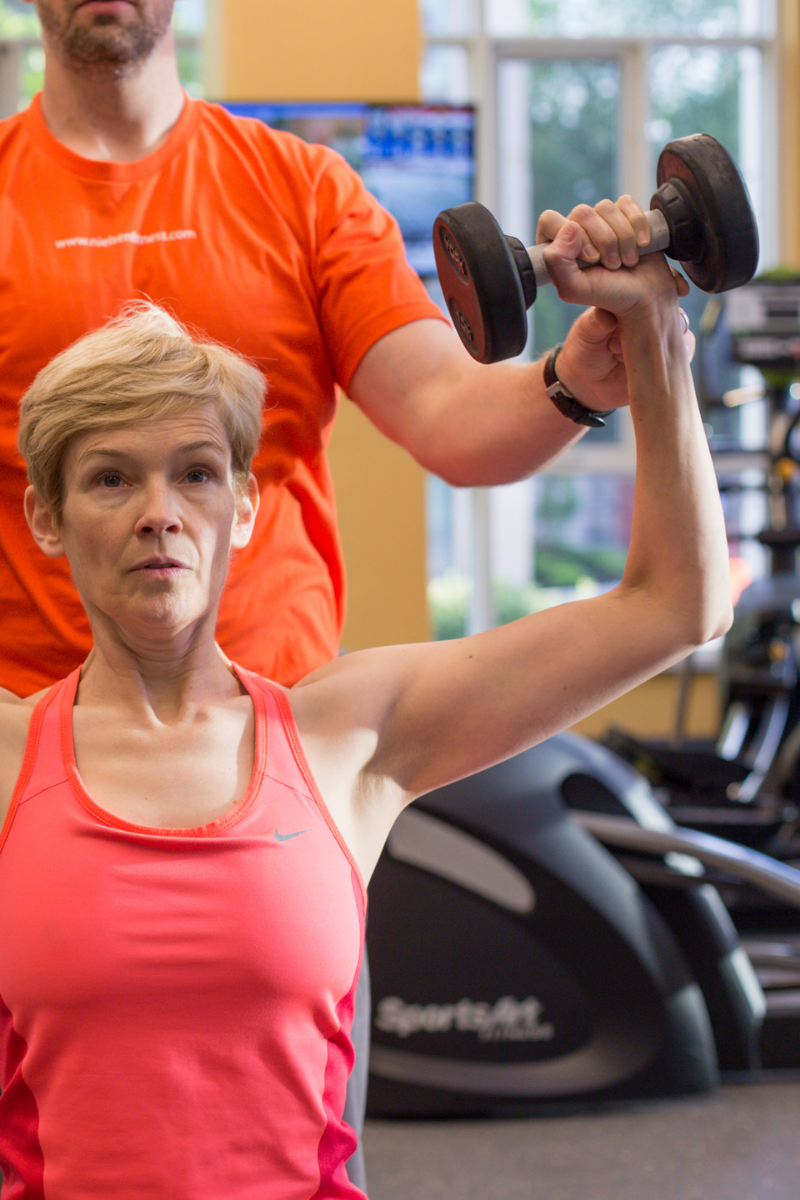
That’s a meaningful gap, and it echoes exactly what the NASA data showed: light-intensity exercise, on its own, often isn’t a strong enough signal to prevent age-related bone loss, while properly dosed, heavier loading gives the skeleton a genuine reason to adapt. That said, the word we want to emphasize from LIFTMOR isn’t heavy, it’s supervised. The women in that trial weren’t handed a barbell and told to figure it out. Their loading was carefully calibrated, technique was monitored, and progression was managed by trained professionals over time. That supervision is precisely what allowed a population often considered fragile to safely access a training stimulus strong enough to build bone, without a spike in injuries.
This is the piece that sometimes gets lost when people hear that they need to lift heavy to build strong bones after 50. They picture themselves attempting a personal record on day one. That’s not what the evidence supports, and it’s not what we teach at Nielsen Fitness.
NUTRITION PROVIDES THE MATERIALS, LOADING PROVIDES THE REASON
It’s worth being clear about the role nutrition plays to build strong bones after 50. Adequate protein, calcium, and vitamin D give bone the materials it needs to rebuild (think of them as the bricks and mortar), but mechanical loading is what tells the body a stronger skeleton is actually necessary. Nutrition alone can’t recreate the effect seen in trials like LIFTMOR, and no amount of dietary optimization compensated for insufficient loading in the NASA data. Nutrition supports bone remodelling and progressive resistance training is what actually initiates building strong bones after 50. Both matter, they aren’t interchangeable.
WHY BUILDING STRONG BONES AFTER 50 ISN’T OPTIONAL
The real-world stakes for building strong bones after 50 are significant. Hip fractures in particular are one of the clearest markers of how bone health intersects with independence and longevity. According to surveillance data compiled by the Public Health Agency of Canada’s Canadian Chronic Disease Surveillance System (2020), roughly 22.8% of older adults who experience a hip fracture die of any cause within the following year. This isn’t meant to alarm anyone, but rather to underscore that a hip fracture is rarely just a hip fracture. It often marks a turning point that affects mobility, independence, and overall quality of life, which is exactly why building and preserving strong bones after 50 proactively (well before a fracture ever occurs) is one of the most protective things a person can do for their future self.
HOW WE APPROACH BUILDING STRONG BONES AFTER 50
None of this means we tell new clients to walk in and start deadlifting heavy on day one. That approach ignores everything the research actually teaches us: that safe, effective loading for building strong bones after 50 is a progression, not a single heavy session. Our job as your in-home and virtual personal training team is to assess where you’re starting from, then build a program that gradually increases mechanical demand on your bones, joints, muscles, and nervous system at a pace your body can adapt to. Over weeks and months, that might mean progressing from bodyweight squats to loaded ones, from light resistance bands to free weights, from controlled movements to ones that include safe impact. The goal is always the same: give your skeleton a real reason to stay strong without skipping the steps that make that process safe.
Book your free first session with Nielsen Fitness today, and let’s build a plan that helps you start building strong bones over 50 for the years ahead.