
September 16th, 2026
Strong at Home, Part 2: How to Progress Strength Training Without Heavier Weights
In Part 1 of this series, we made the case that meaningful strength training comes from intelligent, progressive resistance, not necessarily from a barbell loaded with plates. As a team of in-home and virtual personal trainers, that principle shapes almost everything we build for clients who train in condos, basements, hotel rooms, and backyards. But making that case in theory is one thing. Showing exactly how to progress a strength training exercise when you don’t have a heavier dumbbell to grab is another. That’s what this article is for. We’re going to use the push-up as our main example, then apply the same thinking to squats, lunges, step-ups, and isometric holds.
WHY STRENGTH TRAINING DOESN’T REQUIRE MORE WEIGHT
Progressive overload is often reduced, in gym culture, to a single idea: add more weight to the bar. That’s one way to increase demand on a muscle, but it’s far from the only one. A well-known 2022 study published in PeerJ compared two groups of resistance-trained lifters over eight weeks: one that increased load while holding repetitions steady, and one that increased repetitions while holding load steady. Both groups achieved comparable increases in muscle thickness. That finding matters because it confirms what we see constantly in home strength training: the body responds to increased demand in whatever form that demand takes, whether it’s more reps, slower tempo, a longer range of motion, or a more difficult lever.
Your reps and sets, tempo, rest periods, range of motion, and exercise selection all create a strength training stimulus that your muscles have to adapt to, and each of these can be tracked and progressed just as deliberately as weight on a bar. This is the mental shift we try to help every client make: weight is one dial among several, not the only dial that matters.
THE PUSH-UP AS A CASE STUDY
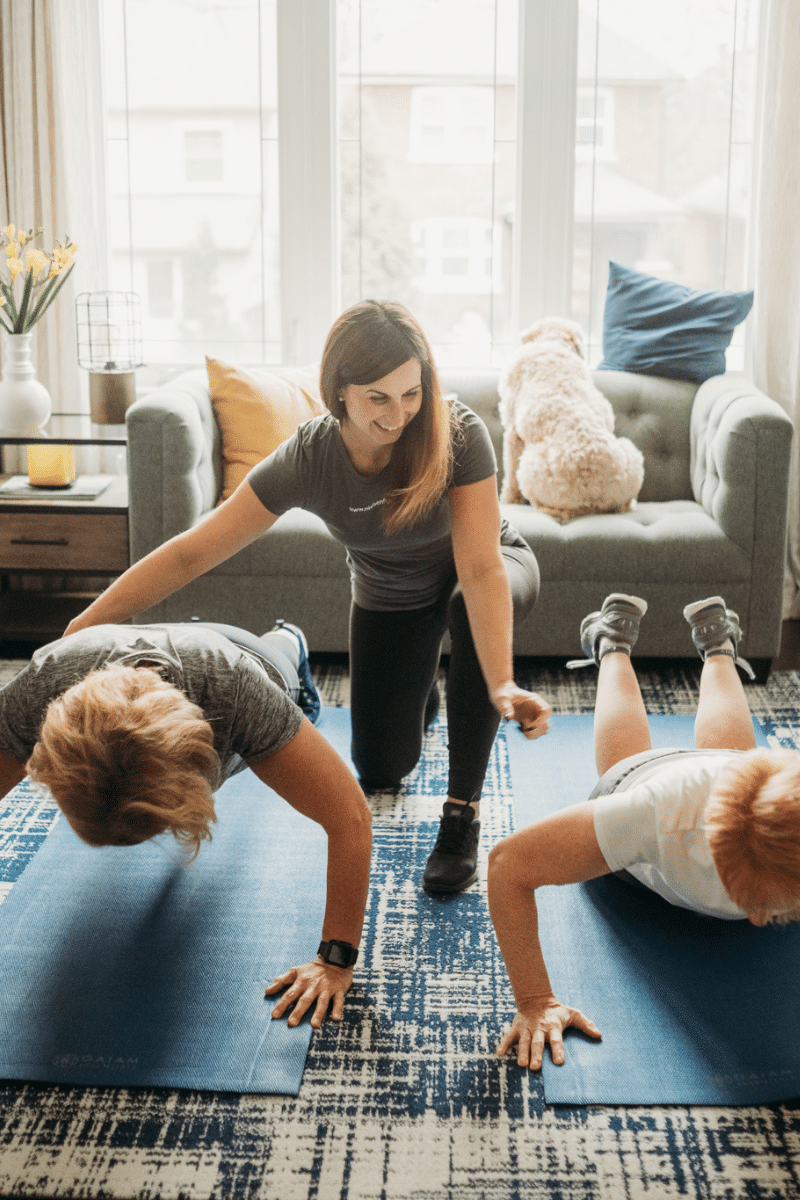
The push-up is one of the best examples of how much progression is available inside a single bodyweight movement. Many people either do push-ups the same way for years, or abandon them once they feel too easy, assuming there’s nowhere left to go. In reality, a push-up can be made significantly harder without changing the exercise at all.
The first lever is the eccentric, or lowering, phase. Slowing the descent from a fast, uncontrolled drop to a controlled three, four, or even five-second lowering phase changes the exercise substantially. Strength training research on eccentric tempo has found that longer eccentric durations, in the range of three to six seconds, are associated with greater metabolic stress and muscle damage: two of the mechanisms believed to drive muscle growth (Frontiers in Physiology, 2025). Practically, this means a push-up performed with a slow, controlled descent is a meaningfully different (and more demanding) exercise than the same movement performed quickly.
The second lever is the pause. Adding a one or two-second pause at the bottom of a push-up, chest just above the floor, removes the elastic rebound that momentum normally provides and forces the muscles to generate force from a dead stop. This is a small change with an outsized effect on difficulty, because it eliminates the energy return that a bouncy repetition provides.
The third lever is range of motion. A push-up performed with the hands elevated on a low step, or with the feet elevated to increase the working range at the shoulder, changes the total distance the body has to travel and shifts more relative load onto the chest and shoulders.
The fourth lever is controlled acceleration on the way up. Rather than exploding out of the bottom position as fast as possible, deliberately controlling the speed of the concentric (lifting) phase, particularly through the sticking point, keeps tension on the working muscles for longer and reduces the ability to cheat the rep with momentum. Combined: a slow eccentric, a pause at the bottom, a fuller range of motion, and a controlled concentric phase can turn a push-up that a client could once do thirty times into an exercise that is genuinely challenging for only eight or ten repetitions. That’s with no added weight whatsoever!
APPLYING THE SAME PRINCIPLES TO SQUATS AND LUNGES
The exact same strength training levers apply directly to the squat. A bodyweight squat performed with a four-second lowering phase, a one-second pause in the bottom position, and a controlled rise back to standing is a dramatically different exercise than a quick, bouncy bodyweight squat. Research on eccentric tempo in the squat specifically has found that a slower eccentric phase may optimize muscle growth in the quadriceps and support strength gains, alongside changes in muscle fiber characteristics, compared to a fast eccentric tempo (Frontiers in Physiology, 2025).
For lunges, range of motion and unilateral stability become the primary levers. A rear-foot-elevated lunge (using a chair or step behind the working leg) increases the working range at the front hip and knee and shifts significantly more demand onto a single leg at a time. Slowing the descent into the bottom of the lunge and pausing before driving back up applies the same tempo principles we described for the push-up and squat.
STEP-UPS AND ISOMETRIC HOLDS
Step-ups are a natural extension of these same ideas, and they make excellent use of a staircase or a sturdy platform. Raising the height of the step increases the range of motion and the demand on the working leg. Slowing the lowering phase back down to the ground, rather than simply stepping down quickly, adds a meaningful eccentric challenge. Pausing briefly at the top, balanced on one leg, adds a stability and isometric component that a fast, momentum-driven step-up doesn’t provide.
Isometric holds (think wall sits, planks, or glute bridges held at the top position) deserve a strength training category of their own, because they don’t involve movement at all. Even so, they remain genuinely effective. For isometric holds, progression comes from extending the duration of the hold, increasing the intensity of the muscular effort within the hold, or adjusting the joint angle to a more challenging position. Again, this is all without adding weight.
PROGRESSIVE OVERLOAD IS A STRENGTH TRAINING TOOLBOX
The thread connecting all of these examples is that progressive overload is a strength training toolbox with several compartments, and adding weight is just one of them. Tempo, pause, range of motion, controlled acceleration, unilateral loading, and isometric duration are all legitimate, evidence-supported ways to keep demanding more from a muscle. When we design home and virtual programs for clients, we’re constantly rotating through these levers, often changing one variable at a time so we can track exactly what’s driving improvement and keep a program feeling fresh over months of consistent training.
This is also why the pairing of this two-part series matters. Part 1 established that a small space and a modest set of tools can absolutely support a real strength program. This article is about the mechanics of making sure that program never stalls, even if you never add another pound to your dumbbells. Together, they represent the core philosophy behind how our team approaches in-home and virtual coaching: strength is built through intelligent programming and progression, not simply through access to heavier iron.
READY TO TAKE YOUR STRENGTH TRAINING FURTHER?
If you’d like a strength training program that’s built specifically around your space and your equipment, and a smart progression plan that keeps working long after the basics start to feel easy, our team of in-home and virtual personal trainers at Nielsen Fitness is here to help. Book a consultation with Nielsen Fitness today and let’s build your next phase of progress together.