
October 16th, 2026
Recovery Done Right: 5 Signs to Dial Back Your Training
More training does not automatically mean better results. Adding workouts and pushing harder on every set works for a few weeks, then progress stalls and energy drops. The instinct is to do even more, but the better move is more muscle recovery, not more work
We believe more exercise is not automatically better exercise. A workout is the signal that tells your body to adapt. The adaptation itself happens afterward, while you rest, eat, and sleep. Muscle recovery is not time off from your program. It is the part of your program where strength, endurance, and fitness are built. When muscle recovery falls behind the work you are doing, results slow down and injury risk goes up.
In this post, we cover the signs that your program needs more muscle recovery, why training less can sometimes lead to more progress, and the steps you can take this week.
CHANGES IN PERFORMANCE
The clearest warning sign is a drop in performance that lasts. Everyone has an off day, but a pattern is different. The hallmarks of overtraining syndrome include “decreased athletic performance in the setting of increased training intensity” (Sports Psychiatry, 2024). Weights that felt manageable last month now feel heavy, your pace slows on walks or runs, and your usual number of reps becomes a struggle. Your heart rate may also run higher than normal at the same effort.
Progress that has stopped for three or four weeks, despite consistent effort, deserves attention. Stalled weeks like these are often a muscle recovery problem rather than an effort problem. Write down your key lifts so you can see the trend instead of guessing. Strong muscle recovery habits protect the progress you have already earned.
SORENESS THAT WILL NOT GO AWAY
Some soreness after a new exercise is normal. Soreness that lingers beyond 48 to 72 hours, or that is still present when your next session starts, signals that muscle recovery is incomplete. Other signs include muscles that feel tight and heavy, joints that ache, and small nagging pains that keep returning. Sore muscles do not produce full strength, so your next workout is weaker and your form gets sloppier. That combination is how minor aches turn into injuries.
Soreness is also different from sharp or pinching pain, which should be assessed rather than trained through. Our post on exercise for back pain explains how to tell the difference and keep moving safely.
SLEEP THAT GETS WORSE
Sleep is where most muscle recovery happens, which makes it one of the most reliable early warning signs. Heavy training can disturb sleep. You may fall asleep easily but wake at 3 a.m., toss and turn, or wake up unrefreshed after a full night in bed. A resting heart rate that creeps up over several days is another clue. A 2024 meta-analysis in endurance athletes found that overreaching had a large effect on objective sleep quality, although the size of the change was small (PLOS ONE, 2024). One bad night means little. A trend across a week or two means more. Poor sleep then reduces muscle recovery further, and the cycle feeds itself.
FADING MOTIVATION
Motivation is a recovery signal that people often overlook. Looking forward to a session is normal. Dreading it, negotiating with yourself to skip it, or feeling irritable and flat before you start is not. A 2025 systematic review reported that high training volumes intensified negative moods, including fatigue and tension, and that “load-reducing interventions resulted in emotional improvements” (Sport Sciences for Health, 2025). In plain terms, low motivation can reflect a body that needs more muscle recovery, not a weak mindset.
LOW ENERGY ALL DAY
Training should leave you feeling better over time. Instead, you may notice that coffee barely helps, afternoon crashes hit harder, carrying groceries or climbing stairs feels more tiring, or you catch every cold that goes around. Constant tiredness and frequent illness suggest that your total stress load is larger than your current muscle recovery capacity. That load includes workouts, work, family demands, and poor sleep. The body does not separate gym stress from life stress. Both draw from the same account.
WHY REDUCING VOLUME OR INTENSITY CAN IMPROVE PROGRESS
Cutting back feels like going backward, but it often does the opposite. Training volume, which is the total sets and reps, and intensity, which is how hard each set feels, are both forms of stress. Stress produces results only when your body can recover from it. Once the stress exceeds muscle recovery, extra work adds fatigue without adding adaptation.
Pulling back for a short period lets fatigue drain away and lets the benefits of earlier training show up. The same 2024 review in PLOS ONE explains that while overreaching lowers performance, “appropriate recovery can result in improved performance compared with baseline levels” (2024). Researchers call this supercompensation. Muscle recovery is what turns hard work into progress. Planned lighter weeks, often called de-loads, are a standard coaching tool for this reason, and most people hold on to their strength with far less training than they expect. Our guide on how often to strength train after 50 explains how harder and lighter sessions fit together.
PRACTICAL TIPS YOU CAN USE THIS WEEK
These muscle recovery tips take only minutes to apply. Start with sleep. Aim for 7-9 hours, with a consistent bedtime and wake time. Put screens away 30 to 60 minutes before bed and keep the bedroom cool and dark. This is the most effective upgrade to muscle recovery available, and it costs nothing.
Next, reduce one variable by about a third. Pick either volume or intensity, not both. Drop one set from each exercise, or keep the sets and lower the weight by about 10 percent. Leave 2-3 reps in reserve on most sets so no set turns into a grind. Hold that change for one week and notice how you feel.
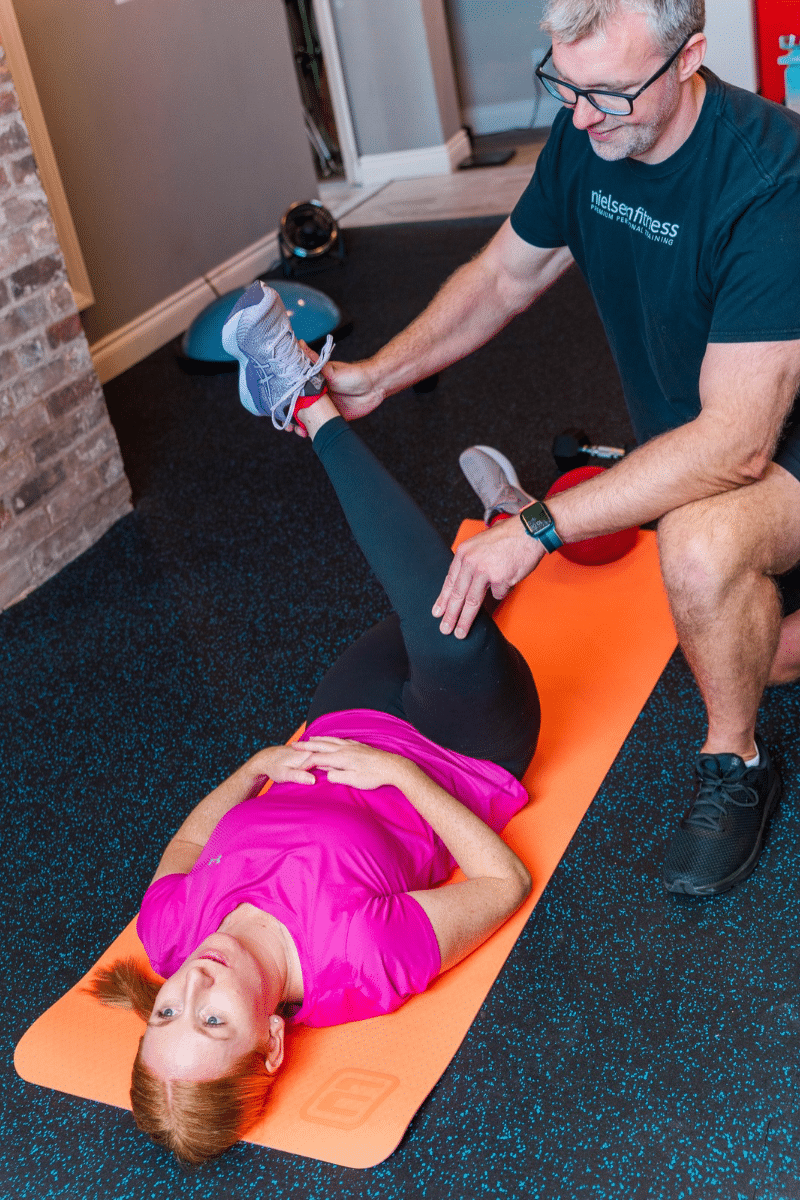
Then protect your rest days. Rest days are part of the program. Easy walking, gentle mobility work, and light stretching support muscle recovery by keeping blood moving without adding stress. Leave at least one full day between sessions that train the same muscles. Our article on strength training without heavier weights shows how to keep progressing through tempo, technique, and range of motion instead of constantly adding load or sets.
Eat enough and drink water through the day. Protein supports muscle repair, and a palm-sized portion at each meal is a solid starting point. Under-eating while training hard is one of the quickest routes to poor muscle recovery.
Finally, track simple markers. Each morning, rate your sleep, energy, soreness, and mood from one to five. Three to five days of low scores in a row is your cue to lighten the next session. A written log takes under a minute and removes the guesswork from muscle recovery decisions.
HOW TO KNOW YOU ARE BACK ON TRACK
After a week or two of lighter training, you should notice better sleep, fading soreness, and lifts that feel smoother. Rebuild gradually by adding back a set or a small amount of weight, rather than jumping straight to your old routine. Midlife and older clients often need more muscle recovery between hard sessions, and that is a normal part of training rather than a set-back. Our post on exercise and menopause shows how we keep training simple and deliberate for women through that stage of life.
OUR APPROACH AT NIELSEN FITNESS
Every client we train has a different muscle recovery capacity, shaped by age, sleep, stress, work, and training history. A good program adjusts to the person and the week. Our trainers check in on sleep, soreness, and energy at the start of sessions, then adjust the plan to match. The best training is the amount you can recover from. Consistent, well-supported muscle recovery beats exhausting workouts every time.
QUESTIONS ABOUT YOUR PROGRAM
If you have more questions about muscle recovery, or want a program built around your body and your schedule, contact us today. Our in-home and virtual personal trainers are happy to help.