
Exercise Injury Prevention Our Method
September 30th, 2026
Exercise for Back Pain: How to Keep Moving Without Making Things Worse
As personal trainers focused on functional strength training, longevity, and fitness for actively aging older adults, we consider exercises for back pain one of our specialties at Nielsen Fitness. Back pain takes many forms: a sudden strain from lifting something awkwardly, sciatica radiating down a leg, a stiff ache that sets in after a long day at a desk, or a dull discomfort that’s simply been a part of daily life for years. Whatever shape it takes, you’re not alone in dealing with it. Low back pain is the single leading cause of disability worldwide, with an estimated 619 million people affected in 2020 alone: a number projected to climb past 800 million by 2050 as populations grow and age (GBD 2021 Low Back Pain Collaborators, 2023). Much of that rise comes down to modern, everyday factors: long hours spent sitting, less time spent moving through a full range of motion, and general deconditioning that leaves the muscles supporting the spine underprepared for real-life demands like lifting, twisting, and carrying.
The vast majority of back pain has no single dangerous structural cause behind it. It’s considered non-specific, meaning it usually stems from a combination of movement, strength, and lifestyle factors rather than one clear injury. That’s encouraging news, because it means the right exercises for back pain, chosen and applied thoughtfully, can make a meaningful difference no matter which form your back pain takes. At Nielsen Fitness, we’ve seen how the wrong approach can prolong a problem that smarter programming could have resolved months earlier.
PUSHING THROUGH VS. INTELLIGENT MODIFICATION
There’s a persistent myth in fitness culture that discomfort during exercise is something to grind through. When it comes to exercises for back pain specifically, that mindset can backfire. Pain is information, not a weakness to overcome, and ignoring it often reinforces poor movement patterns rather than correcting them. Intelligent modification means adjusting range of motion, load, tempo, or exercise selection so a client can keep training productively without flaring symptoms. In fact, a study of exercises for back pain found that approaches like tai chi, yoga, and Pilates “showed a better pain improvement than conventional rehabilitation” (Frontiers, 2023): a reminder that thoughtful exercise selection, not maximum effort, tends to drive results. We see this same principle play out with other painful joints, too; our recent piece on modifying workouts around knee pain covers the same philosophy.
WHY MOVEMENT QUALITY MATTERS MORE THAN MOVEMENT QUANTITY
When someone comes to us in search of exercises for back pain, the first thing we look at is how they’re moving. Poor movement quality (rounding the spine under load, hinging incorrectly, or compensating through one side of the body) often does more to aggravate back pain than the exercise itself. Improving quality usually means slowing things down, teaching proper bracing, and building awareness of hip and spine positioning before adding intensity. This is also why simple daily habits matter as much as workouts; we outline a few of our team’s go-to options in Simple Daily Stretches to Relieve Back Pain.
CORE AND HIP FUNCTION: THE FOUNDATION WE LOOK AT FIRST
Back pain rarely lives in isolation. In our experience, weak or poorly coordinated hips and a core that isn’t doing its job are two of the most common contributors we see. The hips are meant to generate the bulk of force during bending, lifting, and rotating movements; when they’re not doing their share, the lower back often compensates and absorbs stress it wasn’t designed to handle. Similarly, a core that can’t stabilize the spine under load leaves the lower back exposed during everyday tasks. That’s part of why so many exercises for back pain focus on hip strength and mobility; you can read more in The Importance of Building and Maintaining Strong Hips and in our breakdown of the often-overlooked psoas muscle, which plays a direct role in hip flexion and lumbar stability.
CHOOSING APPROPRIATE EXERCISES FOR BACK PAIN
Not all exercises for back pain are appropriate for everyone, which is where a lot of generic programs fall short. The right exercises for back pain depend on what’s actually driving the discomfort. This could be a stiff thoracic spine, weak glutes, poor hip mobility, or simply deconditioning from months of inactivity. Our job is to help identify which of these factors applies to a given person and build a program around it, rather than handing out the same workout to everyone who mentions a sore back. That’s also why we start new clients with a broader movement assessment. Read more about what to expect during your first workout, here.
OUR FAVOURITE EXERCISES FOR BACK PAIN
The glute bridge is one of our favourite exercises for back pain: lying on your back with knees bent, you lift your hips by squeezing your glutes rather than arching your lower back, which directly strengthens the muscles meant to support hip extension instead of letting the spine take over. The dead bug (lying on your back, slowly lowering opposite arm and leg toward the floor while keeping your low back pressed down) is another excellent option, since it trains your core to resist movement rather than create it. This skill protects the spine during twisting or reaching in daily life. For mobility, cat-cow (gently arching and rounding the spine on hands and knees) helps restore comfortable movement through a stiff back without any loading at all, making it a good way to start or end a session. As you work through these, pay attention to which positions ease your discomfort and which ones aggravate it, and let that information guide you. If you’re unsure whether your exercises for back pain are helping or hurting, it’s worth getting a second set of eyes on your form.
PROGRESSING GRADUALLY: A FEW PRACTICAL TESTS
If you’re rebuilding after a bout of back pain, resist the urge to jump straight back into your old routine once things start feeling better. A more reliable approach is to increase only one variable at a time (range of motion, load, or number of reps) rather than several at once, so you can actually tell what your back tolerates well.
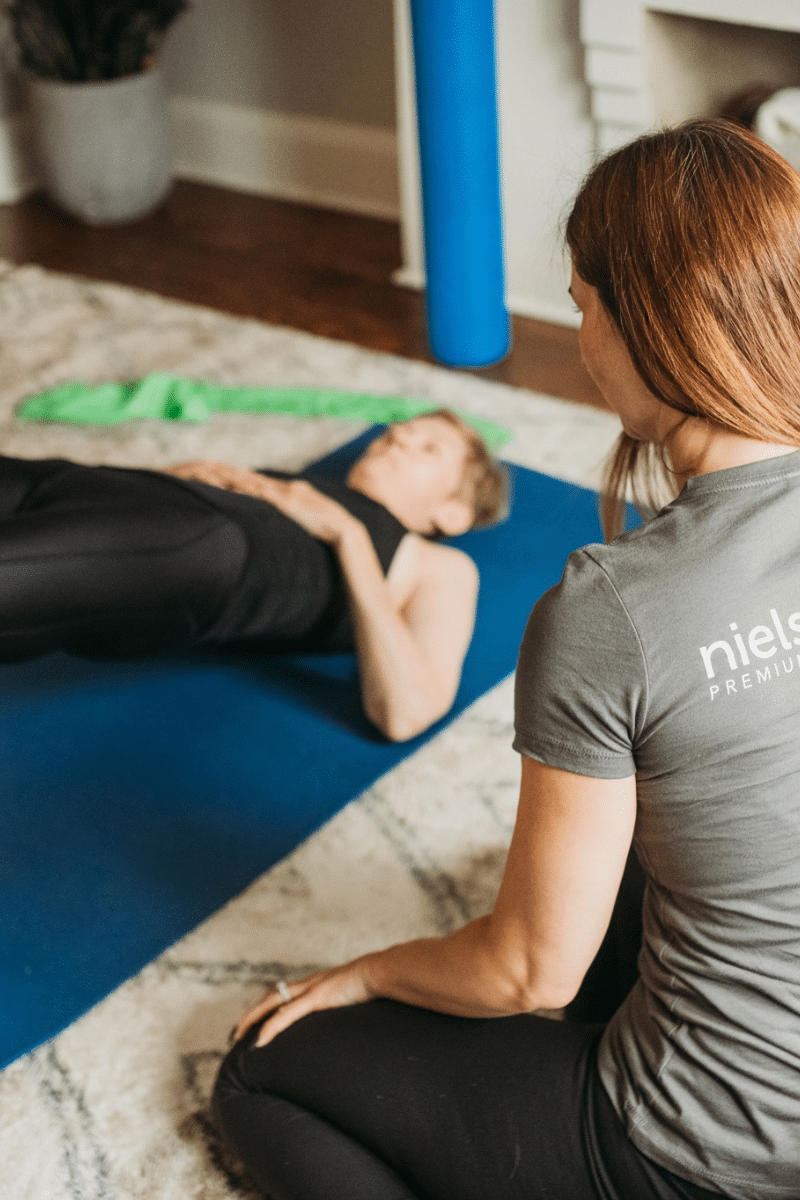
Early on, many of our clients start with a pelvic tilt: a small, controlled movement where you gently flatten your lower back against the floor by engaging your deep core muscles. It teaches spinal control without any real load, which is exactly what a healing back needs first. From there, a bird-dog (extending opposite arm and leg while on hands and knees) is one of our go-to progressions. Bird-dogs help the core to stabilize the spine while the limbs move, closely mimicking the coordination your back needs for everyday tasks like reaching and walking.
If an exercise still feels fine the next morning, you’re probably ready to add a small amount more; if it flares up, back off rather than pushing through it.
MOVEMENTS AND HABITS WORTH AVOIDING
While the right exercises for back pain can speed up recovery, a few common habits tend to slow it down or make things worse. Repeated spinal flexion under load (think traditional sit-ups, crunches, or straight-leg toe touches) is one of the biggest culprits, since it repeatedly bends the spine in a direction that’s already often irritated, rather than building the stability it needs.
Similarly, jumping straight into heavy lifting or high-impact movements (box jumps, running, or loaded twisting) before your back has regained control and endurance tends to reignite symptoms rather than build resilience; these movements have their place, but usually much later in a progression, not at the start. It’s also worth avoiding the instinct to test your back with a movement that causes sharp, radiating, or worsening pain just to see if it still hurts. That kind of pain is a clear signal to modify or stop, not push through, and repeatedly ignoring it can delay recovery significantly.
Finally, be cautious about copying someone else’s program exactly, whether that’s a friend’s routine or a generic best exercise for back pain list online. A movement that works well for one back can aggravate another entirely, especially when the underlying cause differs. None of this means avoiding exercise altogether; it simply means being selective and intentional about which movements you choose and how you progress them.
LET’S BUILD YOUR EXERCISES FOR BACK PAIN TOGETHER
These suggestions are a starting point. The right combination, order, and amount of exercise depends entirely on what’s driving your specific back pain, which is exactly what a trainer can assess in person. If you’re ready to get started, one of our team members can watch you move and build from there. Book your free initial consultation and mini workout with Nielsen Fitness today, and we’ll help you turn these building blocks into a plan tailored to your body and your goals.