
In Home Training Measurement Virtual Training
November 18th, 2026
In-Home & Virtual Trainers Know The Truth Behind Progress – And You Might Not See It in the Mirror Now
The mirror is the slowest reporter in fitness. Visible changes in muscle and body composition take months to build, and even then, the reflection depends on lighting, posture, clothing, and mood. Meanwhile, the body is already making changes that matter more to daily life: movement gets smoother, effort feels lower, and ordinary tasks get easier. Our team at Nielsen Fitness teaches clients to watch for those signals first, because they are real, measurable, and arrive well ahead of any change in appearance. That approach shapes every in-home and virtual personal training program we write.
WHY THE MIRROR LAGS BEHIND YOUR PROGRESS
“Early-phase strength gains in novice athletes are primarily driven by neural adaptations” (Frontiers in Physiology, 2025). In other words, strength training changes the body from the inside first. The nervous system learns to recruit muscle more effectively and coordinate movement long before muscle tissue grows enough to change how you look. A person can feel steadier, stronger, and more coordinated within the first several weeks while the mirror shows almost nothing new. Our in-home and virtual personal training sessions are built around that timeline. Early sessions prioritize movement quality and consistent effort, which gives the nervous system the practice it needs, and we measure what that practice produces.
TAKING NOTE OF BETTER MOVEMENT
Better movement is usually the first change people notice, and it is easy to observe: a squat that used to wobble becomes controlled, getting up from a low chair stops requiring a push from both hands, and reaching overhead no longer pulls the lower back into an arch. These are changes in coordination, joint function, and muscle activation, and none of them show up in a photograph. During in-home and virtual personal training, your trainer watches your movement on camera in real time and cues small corrections, so improvement is named when it happens rather than discovered months later. A hip that hinges instead of rounding the back, a knee that tracks in line with the foot, and a shoulder that moves further without pinching are all progress you can feel before anyone can see it.
THE MARKERS THAT COUNT
Some of the most useful markers of progress already exist in your day-to-day, and steadier balance is one of them. Standing on one leg while putting on a sock, stepping off a curb without a wobble, and walking an uneven path without scanning for every step all reflect how well your legs, hips, and trunk work together. Balance matters most when the ground gets unreliable, which is why our home workout plan for winter footing pairs balance with strength. The same lower-body strength that steadies you also makes stairs easier. Progress here looks like climbing a full flight without pausing, relying less on the railing, and reaching the top breathing more comfortably than you did a month ago. Grip counts too, and carrying all the groceries in one trip is a clear sign of capacity, as we explain in our post on grip strength after 50. Every one of these markers is checked during in-home or virtual personal training.
WATCHING YOUR REPS
Completing more reps with the same weight — or the same reps with easier effort — is one of the clearest signs of progress. We ask our virtual personal training clients to rate effort after each set, because pairing the rep count with an effort rating separates genuine improvement from simply pushing harder on a good day. Progress during in-home or virtual personal training is not a straight line. Poor sleep and high stress can flatten the numbers for a week, and our post on signs your program needs more recovery explains why an easier week can protect long-term gains. When energy is low, our guide to energy boosting workouts shows how to adjust a session without losing momentum.
CONFIDENCE AND DAILY CAPACITY
Daily capacity is the practical result of everything above, and confidence is how that capacity feels from the inside. For example, a 2025 meta-analysis of randomized trials in older women with sarcopenic obesity found that resistance training improved physical function. However, the authors concluded that “the impact on body composition parameters, such as BF%, appears to be limited” (Frontiers in Aging Neuroscience, 2025). That is a specific group, and results vary from person to person, but the lesson applies broadly: function can improve noticeably even when body composition changes more slowly than hoped. Confidence follows that evidence. Trusting your legs on a staircase, lifting a suitcase into an overhead bin, and finishing a full day of errands without needing to sit down all build a sense of capability that no photograph captures. Virtual personal training supports that shift by pointing out each of these wins as it happens, so they are noticed rather than taken for granted.
IN-HOME AND VIRTUAL PERSONAL TRAINING
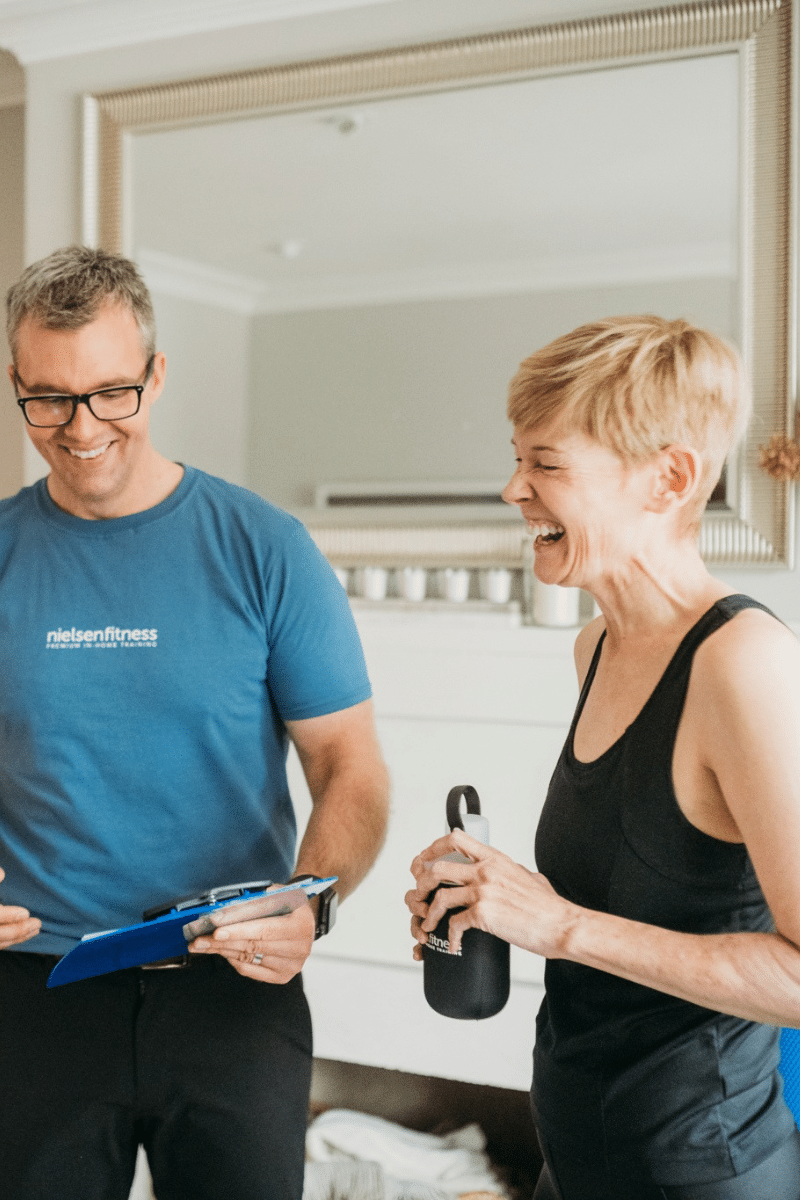
Tracking is where in-home and virtual personal training has a practical advantage. In-home and virtual personal training sessions usually take place in the same space with the same equipment, which keeps benchmarks consistent from week to week. Your trainer records the same markers on a regular schedule, whether that is single-leg stance time, sit-to-stand repetitions, or reps at a set effort, then compares each result with your starting point.
If you’re new to the concept of virtual personal training, our overview of how virtual workouts work covers camera angle and space, and our virtual personal training page describes the service in full.
WHAT TO EXPECT IN THE FIRST MONTH
The first month of in-home and virtual personal training is about building a baseline and a rhythm. Week one establishes starting numbers for balance and repetitions at a set effort. Weeks two and three of in-home and virtual personal training refine technique and add small, manageable increases in load or repetitions. By week four, many people can point to at least one marker that has moved, even if it is a small one, such as a longer single-leg stance or a calmer climb up a flight of stairs. Virtual personal training works best when those numbers are reviewed together, because a trainer can explain what the change means and choose the next step.
MEANINGFUL MEASURES
Here is our invitation to you: choose one measure and track it for the next four weeks. For balance, time a single-leg stance beside a kitchen counter, close enough to touch if needed. For stairs, count the pauses or the railing use on a familiar flight. For strength endurance, count the sit-to-stand repetitions you complete from a sturdy chair in 30 seconds, or the reps you complete at an effort of seven out of ten. For grip, time how long you can hold a loaded bag at your side. Test once a week, at the same time of day, in the same shoes and on the same surface, and write the result in a notebook or phone note along with how the effort felt. After a month, compare week one with week four. A few more seconds, a few more reps, or one fewer pause is meaningful, because it reflects capacity you carry into everyday life. Anyone with a medical condition, dizziness, or pain should check with their healthcare provider before testing and stop any test that does not feel right. In home and virtual personal training makes the weekly retest simple, because your trainer can run it live, note the result, and build your chosen measure into your sessions. The mirror will catch up in its own time.
START TODAY
Progress that cannot be seen yet is still progress, and it is easier to trust when someone is measuring it with you. If you are ready to choose your first measure and build a plan around it, contact Nielsen Fitness to start a conversation with a trainer about in-home and virtual personal training.