
Aging Core Strength Functional Strength
October 17th, 2025
How to Master Semi-Supine Exercises for Strength and Confidence
The team at Nielsen Fitness is always working to make exercise safe, effective, and approachable. One of our favourite positions to help clients build confidence and control is semi-supine. It’s a highly versatile pose that supports proper mind-muscle connection and safety, especially for beginners, people with back issues, and older adults. Read on to learn how our in-home and virtual personal trainers use semi-supine in client programming.
SEMI-SUPINE BASICS
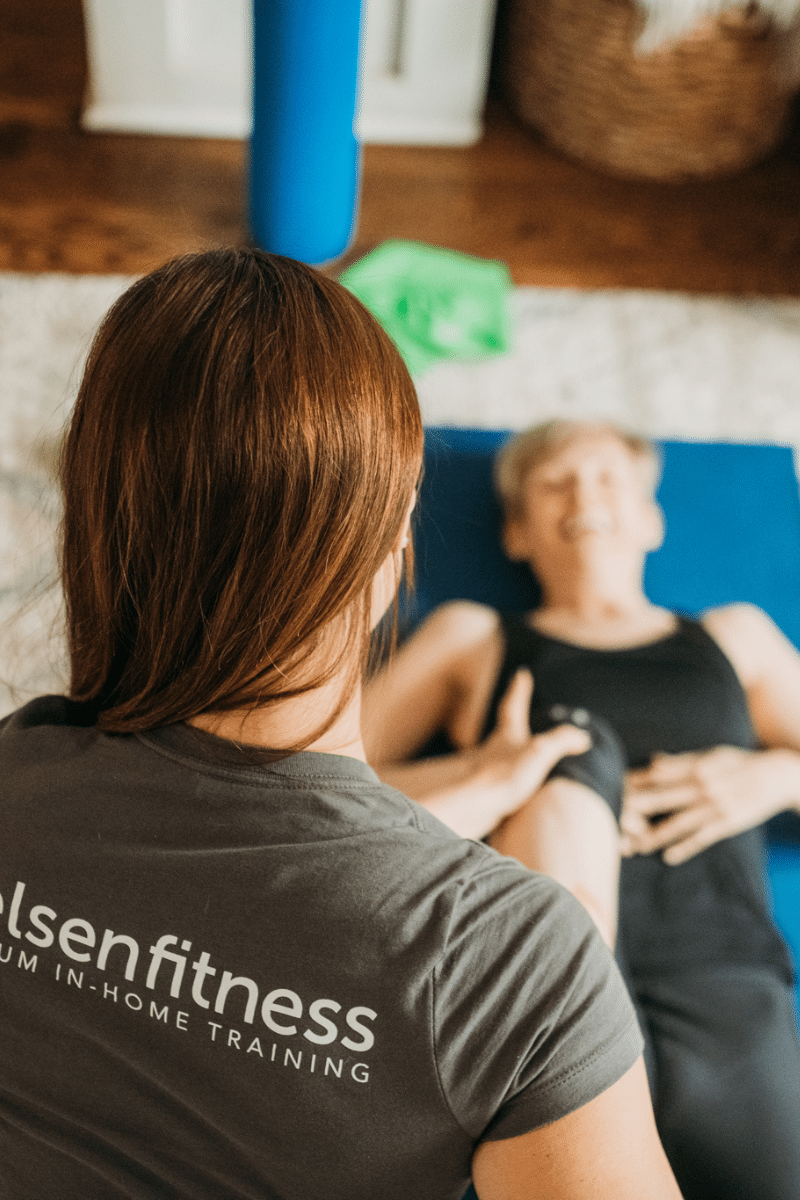
The semi-supine position starts with lying flat on your back. This can be on a mat, bench, or the floor. Your knees should be bent with your feet planted hip-width apart, and your arms can rest at your sides. This position encourages the spine to lengthen, the pelvis to stabilize, and the ribcage to settle into natural alignment.
Though simple, the semi-supine position is an active learning posture. It allows the body to reset and gives you a chance to notice tension, imbalances, and breathing patterns. Many of our in-home personal trainers in Toronto, Collingwood, London, Hamilton, and Ottawa (and virtual personal trainers everywhere) use it as a starting point to teach clients how to engage their core, control their breathing, and prepare for more complex movements.
SAFETY
Safety is the cornerstone of all effective fitness programs, as reducing injury risk is just as important as building strength. The semi-supine position provides a secure environment for exercise because it minimizes the risk of falls, reduces strain on joints, and supports the spine. Unlike many standing exercises, where balance and coordination are required, semi-supine work allows clients to focus on movement without the fear of losing stability.
For older adults who may be concerned about balance issues, this can remove a major barrier to exercise. On top of this, because the floor provides a stable surface, exercises performed in semi-supine are less likely to overload vulnerable areas.
Semi-supine is especially beneficial for those dealing with back pain, which is the “largest cause of disability-adjusted living years based on the WHO survey of the global burden of disease” (National Library of Medicine, 2023). Because the spine is supported by the floor and the knees are bent, pressure on the lower back is greatly reduced. The neutral pelvic position encouraged by semi-supine can also gently relieve tension in the muscles around the lumbar, providing a safe way to practice gentle core activation without aggravating existing issues.
BREATH SUPPORT
Semi-supine is also an excellent tool for teaching proper breathing. When you’re lying on your back, you can feel your ribcage expand and contract with each breath, which provides constant feedback about how you’re breathing. Many people tend to breathe shallowly in their chest, which can increase tension and reduce oxygen efficiency during workouts. In semi-supine, a trainer can guide you to take deeper, diaphragmatic breaths, which improves oxygen delivery to muscles, reduces stress, and enhances focus.
One study published in Scientific Reports (2023) found that participants who practiced slow breathing exercises had lower levels of stress, anxiety, and depression. For clients dealing with anxiety around exercise, learning to breathe in semi-supine can help them feel calmer and more in control during workouts.
BEGINNERS
For beginner trainees, learning movement mechanics can sometimes feel overwhelming. Semi-supine simplifies this process by removing the complexity of balance or an external load. For example, teaching someone how to engage their core muscles can be challenging when they’re standing.
In semi-supine, clients can more easily feel the difference between letting their core relax and keeping it stable. This is ideal for teaching fundamental movements like pelvic tilts, glute bridges, and core activation exercises. These foundational patterns set the stage for squats, deadlifts, and other compound exercises later on.
OLDER ADULTS
Another major advantage of semi-supine is that it allows clients to strengthen their muscles without overloading their joints. For older adults or those dealing with arthritis, strengthening the posterior chain and core in a supported position reduces the risk of pain. In-home and virtual personal trainers can still gradually progress movements in semi-supine by adding resistance bands, small weights, or simply increasing repetitions.
RECOVERY
Semi-supine is also great at the end of a workout to encourage the body to relax and reset, allowing tension in the spine and hips to release while supporting natural breathing. “Proper recovery is a frequently overlooked element of exercise program design, but it can be the difference between long-term exercise adherence and burnout or injury” (American Council on Exercise, 2025). Our trainers often incorporate gentle stretches or guided breathing in semi-supine as part of a cool-down routine.
BUILDING CONFIDENCE
One of the most powerful benefits of semi-supine is the confidence it builds. For someone who is new to or intimidated by exercise, starting with small, achievable movements in a safe position can be empowering. This approach reduces fear around exercise and increases consistency, creating a sense of safety and progress that makes exercise a positive and rewarding experience.
FINAL THOUGHTS
Semi-supine is a powerful tool for safety, learning, and progression. Nielsen Fitness trainers use the position to help clients of all ages build strength, improve their breathing, and learn movement patterns without fear of injury. At the heart of personal training is the goal of making exercise accessible and effective for everyone. Regardless of your fitness goals, semi-supine is a reminder that the simplest starting points often create the strongest foundations. For help getting started, contact us today!