
November 27th, 2026
Mastering Home Workouts: The Real Power of Calisthenics
A home workout with no equipment can look like a compromise next to a fully stocked gym. The evidence and the mechanics say otherwise. Gravity never goes out of stock, and the human body can be leveraged at more angles than any rack of plates allows. Calisthenics treats bodyweight as a dial instead of a fixed number: change the angle, the lever length, the tempo or the number of limbs on the floor, and one movement becomes ten different exercises. This post looks at how far a no equipment home workout can really go, and where its honest limits sit.
BODYWEIGHT IS A DIAL, NOT A NUMBER
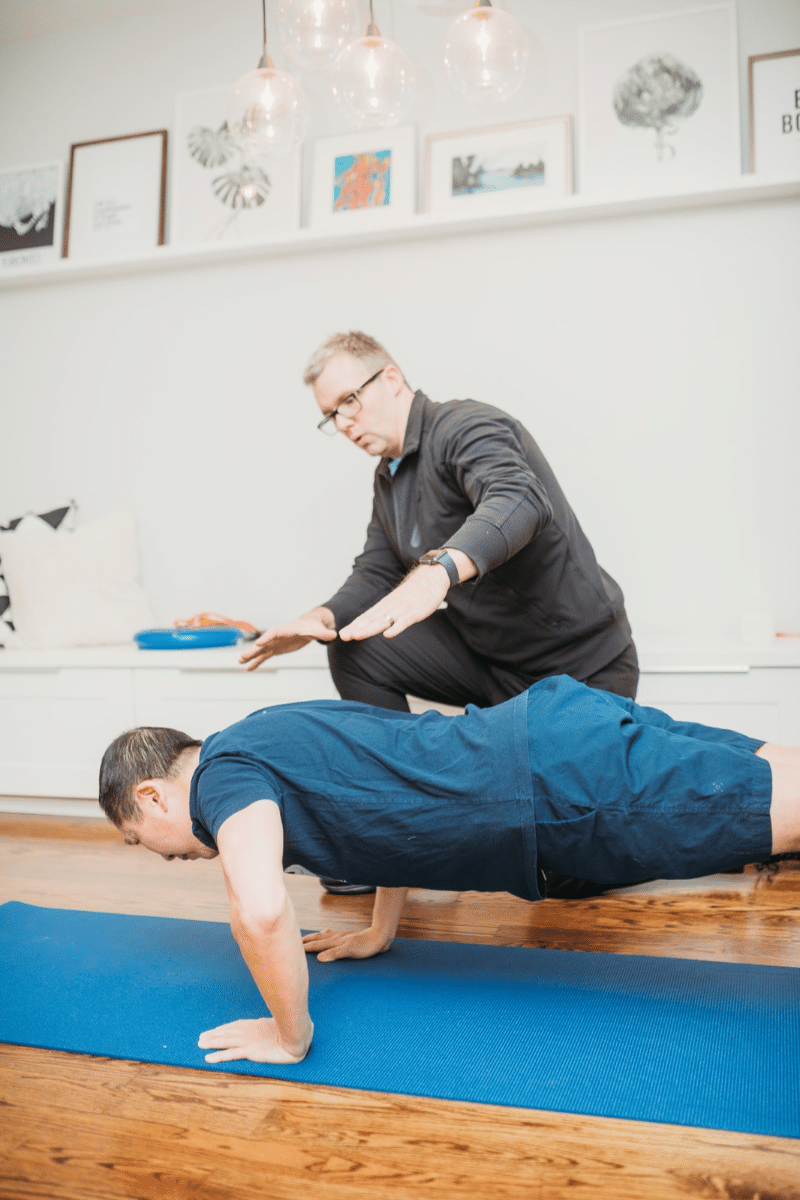
Barbell training raises difficulty by adding plates. Calisthenics raises difficulty by rearranging the body. A wall push-up loads only a small share of body weight. An incline push-up against a kitchen counter loads more, a floor push-up more again, and a push-up with the feet raised on a sofa shifts the work toward the shoulders. Every rung on that ladder is a real increase in demand, which is why a home workout built on no equipment can keep progressing for years instead of weeks. Lengthening a lever, such as moving from a knee push-up to a full push-up, multiplies the load on the working muscles without adding a single pound. Squats follow the same logic, climbing from box squats to full squats, split squats, rear-foot-elevated split squats, and eventually single-leg squats to a chair.
WHAT RECENT RESEARCH SAYS
Skeptics often assume that results require external load, so the data is worth a look. A 2025
network meta-analysis of 102 trials and 4,754 community-dwelling older adults compared machines, free weights, elastic bands, mixed programs, and bodyweight training. Machines produced the largest effects, and bodyweight sat lower in the ranking. Even so, the authors concluded that these modalities “can have large positive effects on strength development in older adults” (Gerontology, 2025). That matters for anyone training with no equipment at home.
Body composition tells a similar story. A 2025 network meta-analysis of 43 randomized trials with 3,154 university students compared exercise types, and “calisthenics emerged as the preferred intervention” (Frontiers in Physiology, 2025). A 2026 review in Nutrients, written about athletes in a bodyweight-based strength sport, notes that “structured bodyweight training can improve muscular strength, endurance, and body composition” (Nutrients, 2026). These are three separate publications covering three different populations, and they point the same way: a no equipment home workout is a legitimate training method, not a placeholder.
PROGRESSION WITHOUT PLATES
Progress in calisthenics comes from five dials, and each can be turned independently. Leverage changes the angle or lever length. Tempo changes speed, so a push-up lowered over four seconds is a different exercise from a fast one. Range of motion changes the distance traveled, as with hands resting on two sturdy books to deepen a push-up. Unilateral work shifts load onto one limb, which is how two-leg squats become single-leg squats. Volume and density change how much work fits into a set amount of time. Rotating through these dials keeps a no equipment home workout challenging long after basic push-ups feel easy, and each dial is free, which suits a home workout better than any gadget.
Strength relative to body size is the quality calisthenics trains most directly. The 2026 Nutrients review describes it as a strong driver of performance in streetlifting, a sport that grew out of the calisthenics movement. Tracking it matters, because the mirror is a slow reporter. Our post on how in-home and virtual trainers measure progress explains why rep quality, tempo, and control are better indicators than appearance, and calisthenics makes all three easy to log.
WHERE BODYWEIGHT TRAINING MEETS ITS CEILING
Honesty about limits makes the case stronger. The same Gerontology analysis ranked machines ahead of bodyweight, and heavy external loads remain the most efficient route to maximal strength. Someone chasing a very heavy squat or deadlift will eventually need a barbell. For general strength, muscle, balance, mobility, and body composition, though, the ceiling of a home workout sits well above where most people ever train. A single-leg squat to a chair, a slow full push-up and a controlled pull-up represent serious strength by any standard.
Pulling is the hardest pattern to cover with no equipment. Inverted rows beneath a table that can safely carry a person’s weight are the usual workaround. Technique also deserves attention, because bodyweight exercises load joints in specific ways. Our guide to a home workout routine and how to adapt an exercise that feels wrong shows how to adjust angles and ranges so that sharp pinches never become a habit.
A SIMPLE WEEK AT HOME
A practical home workout week needs only floor space and about forty minutes per session, spread across three non-consecutive days. One session leans on pushing and trunk work, with incline or floor push-ups lowered slowly, plus planks. A second session covers legs and balance through split squats and single-leg glute bridges. A third session pairs table rows with hip-dominant work and slow, controlled core exercises. Every session needs no equipment beyond a sturdy table and a patch of floor.
Early on, each set stops a rep or two short of failure, then moves closer to it as technique steadies. Once every set of a movement reaches the top of its rep range with clean form, the next progression arrives. That single rule keeps a home workout moving forward without guesswork. Winter makes the lower-body day especially useful, and our home workout plan for safe winter footing shows how strength and balance work prepares the body for icy sidewalks.
START YOUR NO EQUIPMENT TRAINING WITH NIELSEN FITNESS
Bodyweight training rewards expert guidance because the details decide the outcome: which progression comes next, how deep to go, when to hold back. Nielsen Fitness has been bringing the workout to clients’ homes since 2006, and our trainers build every home workout around the person doing it, whether that means a no equipment plan for a small apartment or a blend of bodyweight and available equipment. Contact Nielsen Fitness to request a free first workout and start a home workout practice that grows with you.