
December 12th, 2025
Warrior Pose: Why We Love This Exercise
Warrior poses are a great way to elevate your endurance, mobility, stability, and focus. They’re among the most powerful tools for building functional strength and improving alignment, helping to create a grounded, stable foundation while opening the hips, strengthening the legs, and sharpening concentration. In this post, we’ll discuss the different versions of the warrior pose and how our in-home and virtual personal trainers use them in fitness programming.
WARRIOR POSE BASICS
There are several variations of warrior poses:
Warrior/Virabhadrasana One: From a lunge position, turn your back foot out about 45 degrees and press the heel into the floor. Square your hips forward, lift your arms straight overhead with your shoulders down, and bend the front knee as close as you can to 90 degrees.
Warrior/Virabhadrasana Two: Start in a lunge position. Turn your back foot out 90 degrees, and bend your front knee as close to 90 degrees as possible. Now extend both arms out long, parallel to the floor and over top of your legs.
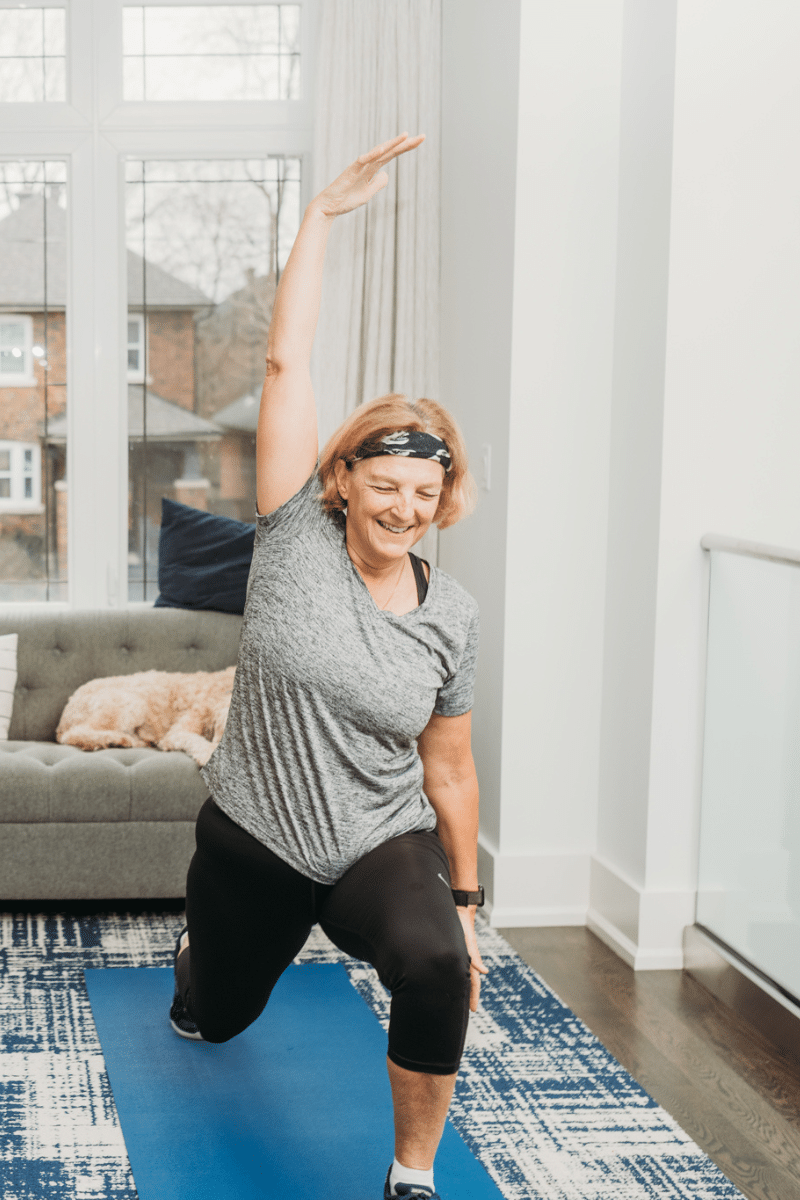
Reverse Warrior (Viparita Virabhadrasana): From warrior two, keep your front knee bent while sliding your back hand down your back leg (or behind your back) and sweeping your front arm back and overhead.
Warrior/Virabhadrasana Three (Advanced): Shift your weight onto one leg, hinge forward at the hips, and extend your other leg straight behind you while reaching your arms forward or to the sides. Keep your hips square to the floor.
Want to see Warrior poses in action? Check out our reel!
THE PURPOSE
Warrior poses were originally designed to embody strength, focus, and readiness: qualities that translate seamlessly into fitness training today. These poses target major muscle groups in the legs and core, reinforce stable joints, and improve your ability to move with intention. They’re particularly effective for cross-training because they strengthen underused stabilizers while promoting better body awareness.
THE EFFECT
Warrior poses integrate strength, balance, and mobility while training the body in multiple planes of motion, helping to prevent common training imbalances. They also encourage mindful breathing, which enhances recovery and reduces stress: something our in-home and virtual personal training clients appreciate in their routines.
THE LEGS
Warrior poses strengthen and improve endurance in the legs by placing the lower body in strong, sustained, weight-bearing positions that challenge multiple muscle groups at once. In warrior one and two, the deep bend of the front knee activates the quadriceps and glutes, while the extended back leg engages the hamstrings and calves to maintain stability and alignment.
Holding these poses for longer periods builds muscular stamina, teaching the legs to stay powerful and steady under load. Warrior three further enhances endurance by requiring balance on a single leg, demanding both strength and control from the stabilizing muscles.
THE HIPS
Warrior poses are particularly excellent for your hips. The split-leg positioning helps open the hip flexors (which often become tight from sitting) while also strengthening the glutes and deep stabilizing muscles that keep the pelvis aligned. Over time, this combination of activation and stretch can reduce stiffness, improve posture, and enhance lower-body endurance for everyday movement.
THE ANKLES
“The importance of ankle strength in exercise routines is often underestimated. However, the ankle plays a vital role in the kinetic chain to keep our base stable for movement” (Brett Warner, P.T., D.P.T., C.S.C.S. of Bespoke Treatments for Men’s Health, 2025). Warrior poses improve ankle mobility and stability by engaging the muscles and joints through controlled, weight-bearing movement. In these stances, the front ankle moves through dorsiflexion as the knee bends, gently increasing range of motion while the back ankle strengthens in plantarflexion to maintain grounding.
The balance and alignment required in each pose activate stabilizing muscles in the lower leg, including the calves and tibialis (shin) muscles, which support the ankle joint. Over time, this combination of dynamic stretch, muscular engagement, and balance training enhances both mobility and stability, reducing the risk of ankle fatigue or injury during everyday movement.
THE CORE
Warrior poses significantly benefit your core by requiring continuous engagement of the abdominal and back muscles to maintain balance, alignment, and stability. In warrior one and two, the torso must stay upright and centered, which activates the deep core muscles (especially the transverse abdominis and obliques) to prevent collapsing or twisting. Warrior three intensifies this engagement by challenging you to balance on one leg while keeping the body in a long, straight line, demanding strong support from the entire core.
As these poses build strength and endurance in the muscles surrounding the spine, they create a solid foundation for more advanced movements both on and off the mat. Because “whether you’re focused on strength alone or your flexibility, your core muscles are the root from which all other muscles can do these things in tandem” (Cleveland Clinic, 2023).
FOCUS
Warrior poses are excellent for mental focus because they require presence, concentration, and mindful control of the body. As you hold each stance, you’re balancing strength, alignment, and steady breathing. This naturally draws attention inward, sharpening your awareness of subtle shifts in posture and muscle engagement. The grounding nature of the poses helps quiet distractions, encouraging a calm yet alert state of mind. Over time, practice enhances mental clarity, discipline, and your ability to stay present.
VERSATILITY
Warrior poses are suitable for all ages and fitness levels because they can be easily adapted to meet individual needs while still offering meaningful benefits. Each pose provides a strong, stable foundation, and you can adjust the depth of the lunge, stance width, or use props to make the movements more accessible.
These poses don’t require extreme flexibility and are gentle on joints, making them approachable for beginners yet still challenging for more advanced trainees. Gentle yoga poses have even been shown to ease some of the discomfort of tender, swollen joints for people with arthritis, according to a 2014 Johns Hopkins review. This versatility allows people of varying abilities to practice safely and progressively, promoting confidence and functional movement at any stage of life.
PROGRAMMING
We love incorporating warrior poses in warm-ups, cool-downs, or dynamic strength sessions. They work particularly well before lower-body strength training because they warm up the hips while activating the glutes and core. They’re also ideal on active recovery days when you want to improve circulation and maintain flexibility without high impact.
Our older adult clients enjoy practicing warrior poses to maintain good balance and general stability, which is key to preventing falls later in life.
FINAL THOUGHTS
Incorporating warrior poses into your workouts is a simple way to build strength, improve mobility, and boost overall body awareness. Whether you’re guided by a virtual personal trainer or supported by one of our in-home personal trainers in Toronto, Collingwood, London, Hamilton, or Ottawa, these poses offer a powerful foundation for long-term fitness. With consistency and proper form, warrior stances can elevate your practice and support every other movement in your fitness routine. Contact us to learn more!