
June 10th, 2025
Why we love band pulls (aka scapular retractions)
If you want to improve your posture, alleviate upper-back discomfort, and further enhance your foundation for total-body strength, scapular retractions should be on your radar. Using a resistance band to perform scapular retractions is a fantastic way to target key postural muscles, enhance shoulder mobility, and prevent injury. It’s a versatile exercise that fits into any routine, making it a favourite for Nielsen Fitness in-home and virtual personal trainers.
THE BASICS OF SCAPULAR RETRACTIONS
“Your back is made up of different types of specialized muscles that enable you to move your body so you can twist, turn, bend, stand, walk, run, and lift. Strengthening your back muscles can help you perform everyday activities such as putting on your shoes or closing a window” (Harvard Health, 2024). Scapular retractions refer to the motion of pulling your shoulder blades (scapulae) back toward your spine. When done with a resistance band, the added tension helps increase muscle activation and strength, making it a valuable tool for both beginners and experienced exercisers. The exercise doesn’t require a gym or heavy weights; a simple loop or long resistance band is all you need to hit your rhomboids, middle trapezius, lower trapezius, and posterior deltoids.
The rhomboids sit between your shoulder blades and spine. They are responsible for pulling the scapulae together and crucial for maintaining upright posture. The middle trapezius, located along the upper back, assists in retracting the shoulder blades and stabilizing the shoulder joint.
The lower trapezius plays a key role in both depression (lowering) and retraction of the scapula, helping with balance and support during upper-body movements. The posterior deltoids (the back part of your shoulder muscles) also contribute during scapular retraction, especially when combined with rowing motions.
Strengthening these muscles helps counteract the effects of prolonged sitting, forward head posture, and rounded shoulders: all common issues seen in our clients who spend long hours at desks or on screens. An in-home or virtual personal trainer can help assess these imbalances and create a program that incorporates scapular retractions to realign the body.
BUILDING STRENGTH
The strength of your scapular stabilizers is crucial for overall upper-body health and function, as these muscles are involved in nearly every arm and shoulder movement. Weak scapular muscles can lead to poor posture, shoulder impingement, neck pain, and back pain. “In 2020, low back pain affected 619 million people globally. It is estimated that cases will increase to 843 million by 2050” (Healthline, 2024). Regularly practicing scapular retractions with a resistance band builds endurance and strength, allowing for greater shoulder mobility, better posture, and improved body mechanics.
OUR TIPS
Click here to see trainer Liz demonstrate scapular retractions – and the tips that follow.
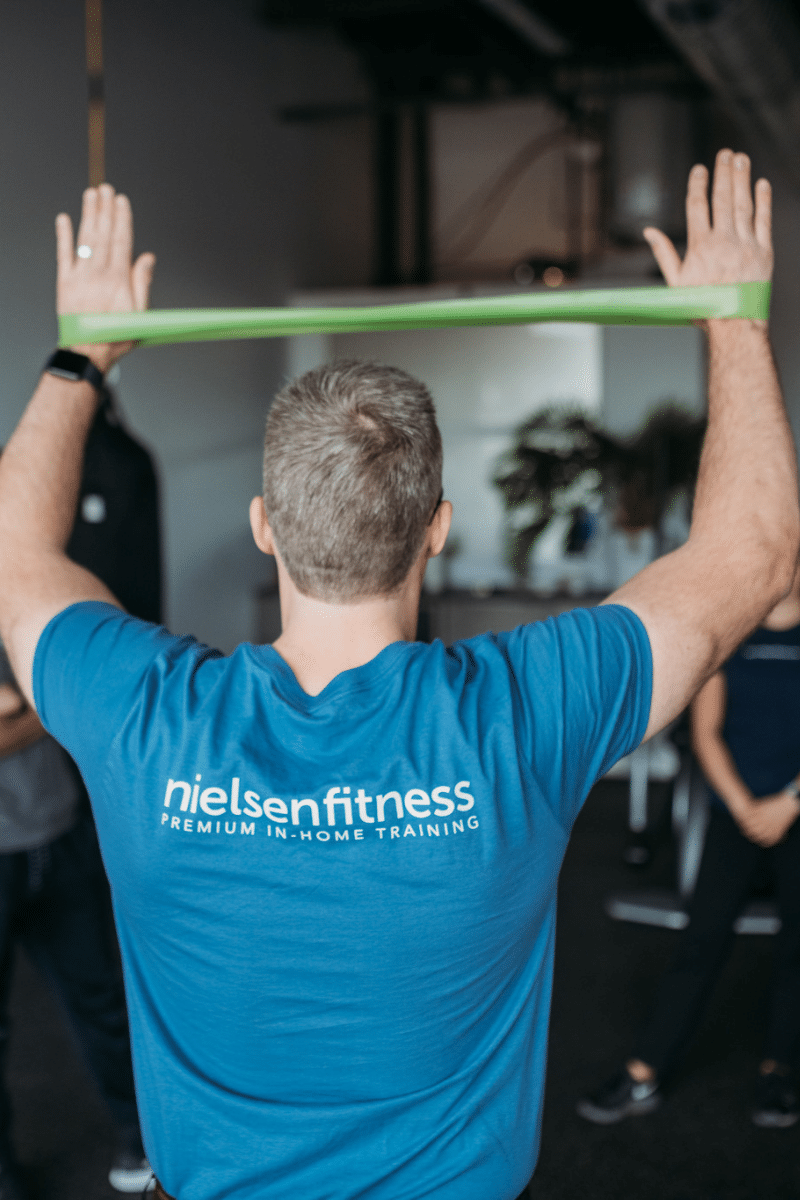
To perform this exercise correctly, stand tall with your feet hip-width apart. Hold one end of a band in each hand with your arms extended straight in front of you. Your palms should be facing down, and there should be slight tension in the band. Begin the movement by slowly pulling your shoulder blades back and together; think about squeezing a pencil between your shoulder blades. Keep your arms long throughout the motion, maintaining a softness in the elbows to prevent joint-locking. Hold the retracted position for a moment, then slowly return to the starting position.
Focus on maintaining a tall spine, a braced core, and an open chest while avoiding shrugging your shoulders. The goal is to activate the mid-back muscles, not the upper traps or neck. You can also achieve core benefits by exhaling and squeezing your abdominals as you retract. With consistent practice, most clients begin to feel a stronger connection to these muscles and notice improvements in posture and shoulder control.
MODIFICATIONS
For beginners or those recovering from an injury, a lighter resistance band can help focus on proper form without excessive strain. Performing the exercise while seated can also help limit compensations and promote better movement awareness. To progress the exercise, slow down the tempo to increase time under tension or simply use a heavier band.
FINAL WORDS
Scapular retractions are a highly effective exercise for strengthening the upper back, improving posture, and supporting shoulder health. They are a foundational movement that can benefit people from all walks of life, whether you’re recovering from an injury, trying to undo years of poor posture, or looking to enhance your overall strength. If you’re looking for fitness support, our in-home personal trainers in Toronto, Collingwood, London, Hamilton, and Ottawa (and virtual personal trainers everywhere) are here to help! Click here to request a free first workout.