
Core Strength Fitness Tips Functional Strength
January 12th, 2026
How To Do Push-Ups: Our Top Tips
Push-ups are feared far and wide among our in-home and virtual personal training clients. Though a staple movement, standard push-ups require a high amount of strength and control in multiple major muscle-groups. “The push-up hammers your chest, shoulders, triceps, and (if you do it right) the core and glutes, too, making it a powerful, total-body exercise. And it’s an excellent indicator of muscular endurance and absolute strength (how strong you are for your body size), which is why it’s a key element in almost all fitness tests” (Men’s Health, 2025). As experienced health and fitness pros, we teach push-ups all the time. We understand the angst, but we’ve also gained a litany of top push-up tips along the way.
THE FORM
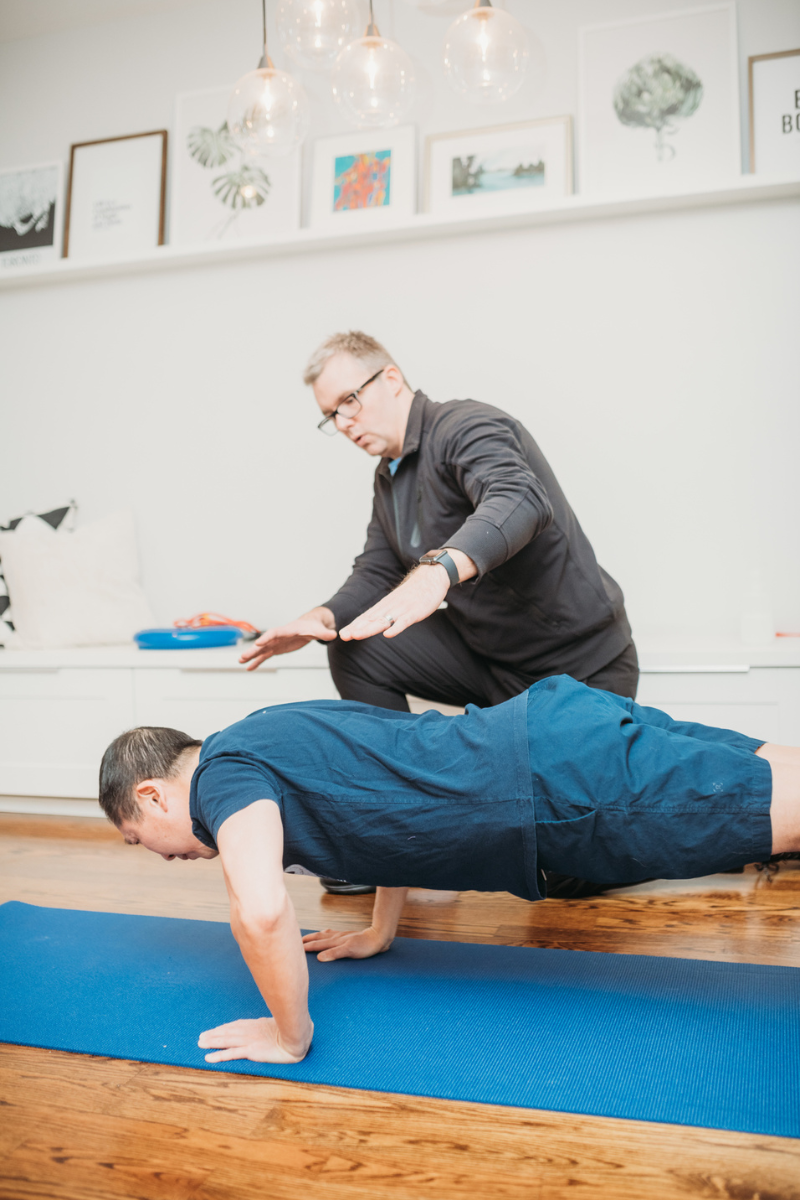
To perform a standard push-up, begin on all fours upon a mat or soft surface. Next, place the palms slightly wider than shoulder-width apart and at chest level. Now step back into a high plank on the toes, then slowly lower down by bending the elbows until your chest gently taps the floor. Elbows should be 45-degrees from the body. During the lowering phase, brace the core, lats, and glutes as the shoulder blades retract. Finally, squeeze the chest and push through the palms to return to a high plank position. This is one rep.
There are many modifications for push-ups (which you can read about in a previous blog post, here), but this is the standard execution.
THE PROBLEM
The main challenge of a push-up is the reason they’re so difficult to master, especially for those naturally lacking in upper-body strength: they pit your own weight against you. This means that the heavier you are, the harder your push-ups will be, relative to your absolute strength.
The catch-22 is the fact that muscle is lesser in mass but higher in weight than fat, which means if you carry a lot of muscle, your push-ups will increase in load. This is tough if you naturally carry more muscle in your lower-body, especially paired with lesser upper-body strength. Very generally speaking, this is why push-ups tend to be more challenging for biological women: these two factors tend to be more common in female genetic makeup.
Aside from natural phenotype (observable physical attributes), there are a couple of other genetic elements to think about when it comes to push-ups, such as height. For example: a longer distance between your feet and shoulders requires more force to achieve full range of motion.
You can read more about the impact of genetics on general fitness, here.
OUR TIPS
Tip 1: Focus on form. It doesn’t matter how many reps you can bang out unless they’re executed properly. Take your time, and be honest with your progress. If your core is collapsing or your hips are too high, you need to modify the exercise.
Tip 2: Brace your core. This is no surprise; our in-home and virtual personal training clients hear it from us about a thousand times a day. However, this step is absolutely essential to almost every compound exercise, including push-ups. Supporting your core will improve your form and safety during movement while also making the exercise feel easier to master, once you get the hang of it. If you’re struggling to maintain a braced core during push-ups, pair modified variations of the exercise with deep core and abdominal training. Our team members can assist with this kind of programming.
Tip 3: Practice supporting movements. Aside from the abdominals, it’s (of course) beneficial to practice exercises that work the chest, shoulders, and triceps as well. Improving the strength of these muscle groups will improve your push-up progress.
Tip 4: Use your breath. Inhale on the lowering phase and exhale as you brace your muscles and push back to the starting position. A more advanced technique is the Valsalva Maneuver (VM), which utilizes a short breath hold. A study published in the National Library of Medicine found that “the VM effectively increases [intra-abdominal pressure], which may assist with spine stability and trunk rigidity during resistance exercise.” To incorporate this approach, inhale at the top of the range of motion, hold your breath during the lowering (eccentric) phase, and exhale as you push back up.
Want to see these tips in action? Check out our reel!
FINAL THOUGHTS
Push-ups aren’t easy, but they aren’t meant to be. Don’t beat yourself up if you’re still struggling to nail your first rep! Mastering this movement takes time, commitment, and regular practice. If you’re in need of further assistance on your strength-training journey, Nielsen Fitness is here to help! Book your free initial consultation here to start chatting with a certified professional, today.