
March 31st, 2025
How to Modify Form According to Your Fitness Goals
As in-home and virtual personal trainers, we know that the execution of an exercise has a big impact on the muscle groups targeted. Small adjustments to your form can shift emphasis from one muscle group to another and optimize training to meet specific goals. Whether you’re aiming to build strength, endurance, or mobility, understanding form modifications can make a significant difference in your training routine. Read on to learn how our in-home personal trainers in Toronto, Collingwood, London, Hamilton, and Ottawa (and virtual personal trainers everywhere) adjust exercise selection to meet client needs.
THE BASICS
There are many different ways to perform a single exercise. In other words, every exercise has multiple variations that are equally correct. Adjusting the range of motion and positioning of a movement can emphasize the activation of certain muscle groups, reduce strain on joints, improve flexibility, and build stability. The ideal choice ultimately depends on your goals and your body. Targeting different areas through careful programming also prevents the overdevelopment of one muscle group while neglecting others.
We’re all built differently. “Yes, there’s such a thing as great and not-so-great form, but that doesn’t mean there’s one ultimate form you need to cram your body into or push through with pain. The best exercise form is always going to be the one that works with your body, not against it” (Livestrong, 2021).
EXERCISE FOR YOUR GOALS: OUR TIPS
Take a standard squat. It primarily works the quadriceps, glutes, and hamstrings, but shifting to a wider (sumo) stance can place more emphasis on the inner thighs and glutes while encouraging mobility in the hips. Sitting back deeper into your heels with a slight forward lean also increases glute engagement. If you’re more interested in building endurance or have issues with stability, a wall-sit (also considered a squat variation) is ideal. If you have limited ankle mobility but would like to increase range of motion, you can try a heel-elevated squat.
Another great example is a push-up, which primarily works the chest, shoulders, and triceps. A narrower hand placement (diamond push-up) shifts even more emphasis to the triceps, while a wider hand placement places more stress on the chest. If you’re more advanced, elevating your feet (decline push-up) increases the workload on the upper chest and shoulders. For newer trainees, our in-home and virtual personal trainers favour wall push-ups, especially if there is weakness in the wrists.
When it comes to lunges, a shorter step emphasizes the quadriceps, while a longer step (as well as a slight lean forward) shifts more focus to the glutes and hamstrings. Adding an incline, lateral, or step-up variation can engage stabilizing muscles even further, while the inclusion of a plyometric (jumping) element dramatically increases intensity.
Lastly, if you’ve ever attended a group-fitness class or used an exercise video, you’ve likely been encouraged not to let your heels go over your toes. Though this guide-post can be helpful for new trainees who are still building basic form, strength, and control, it’s not a hard rule. Letting your knees travel over your toes with control “[allows] your body to handle pressure at your own level, thereby increasing strength for protection as well as nutrient delivery to make your knees last longer” (Men’s Journal, 2025). That said, for someone who has knee problems, knees over toes can place excessive strain on the joints, so a shallower squat with a deeper sit-back may be ideal.
HOW WE CAN HELP
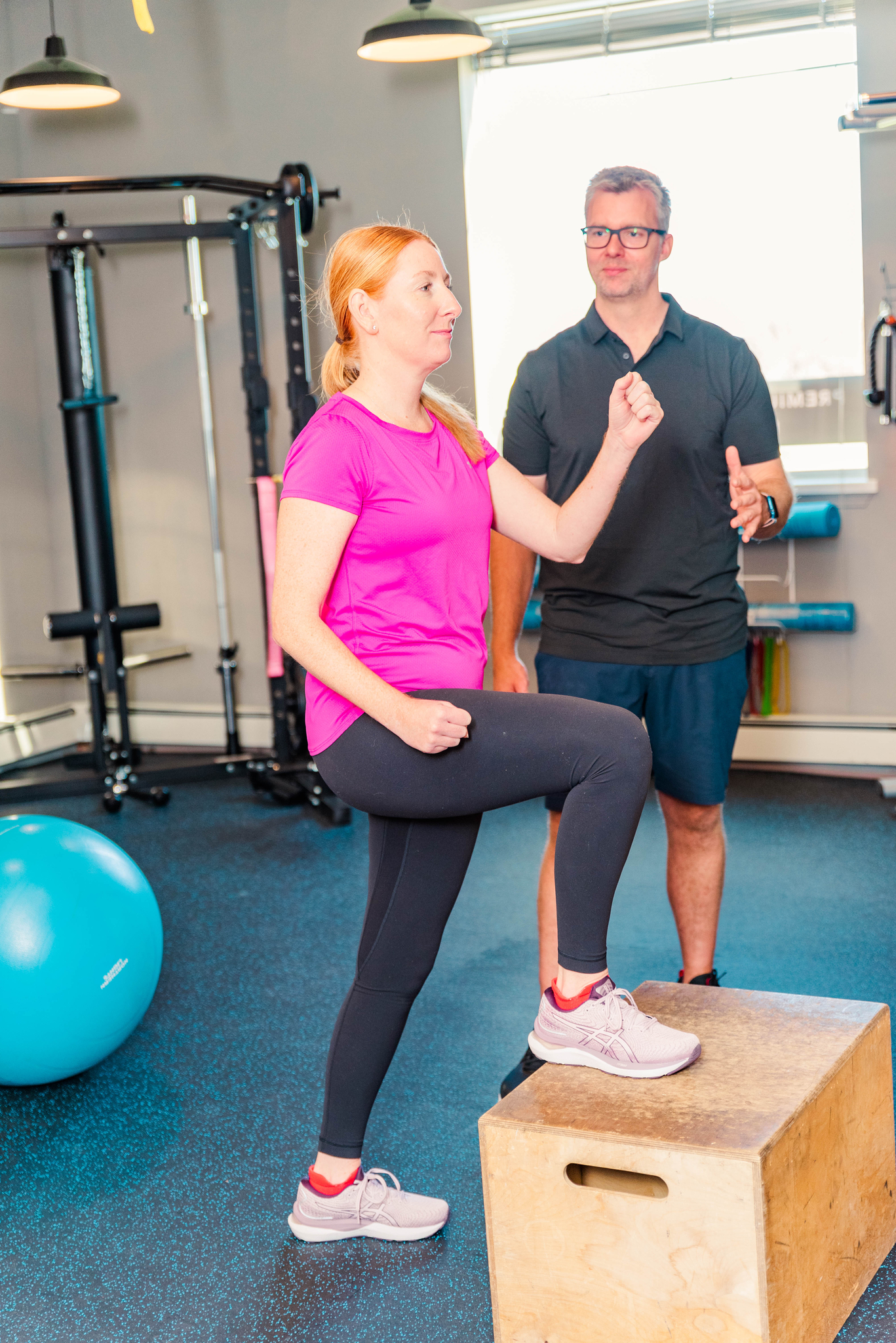
An experienced in-home or virtual personal trainer has the expertise to assess your current form, suggest modifications, and design a personalized program based on your goals. We tailor each exercise to suit your body and your needs, ensuring proper technique for effectiveness. Most importantly, we can modify exercises to accommodate past injuries or mobility restrictions, which is optimal for safety.
FINAL WORDS
“Sticking to an exercise routine is challenging for just about everyone, which is why it is vital to have evidence-based exercise motivation tips and adherence strategies that are proven effective in developing long-term exercise habits” (ACE Fitness, 2024). Understanding how small changes in form can impact muscle activation is key to getting the most out of your workouts. Whether you’re training at home or in a gym, we can help you refine your movements to reach your fitness goals with confidence. If you’re unsure whether your form is optimized for your goals, give us a shout, and we can ensure you’re training smarter, not just harder.