
February 12th, 2025
How to track fitness progress (without a scale)
During the pop-culture fitness boom in the 1970s and 80s (think Arnold Schwarzenegger and Jane Fonda!), the primary focus of most exercise routines was to lose weight. More often than not, this progress was tracked with a scale. While being aware of your weight can be helpful for some, it’s harmful for many, and weight alone doesn’t tell the full story of your health.
Factors like muscle gain, fat loss, and overall well-being can’t always be measured by a number on the scale. Read on to learn some of the Nielsen Fitness team’s alternative methods to track the progress of our in-home and virtual personal training clients, without fixating on weight.
How to track your progress: our method
PHOTOS
Taking progress photos can help you visually track changes in your body that won’t necessarily align with weight. Comparing before and after images over a period of time can help you see muscular development and definition you may not have had before, even if the scale remains the same. It’s important to remember that muscle is heavier than fat, and gaining muscle while losing fat may offset weight-loss.
Our in-home personal trainers in Toronto, Collingwood, London, Hamilton, and Ottawa (and virtual personal trainers everywhere) offer the option of capturing starting photos during an initial training session. Based on goals and current level of fitness, we’ll set a timeline for follow-up images to track changes. We’ll snap photos from the front, side, and back under the same lighting and conditions (clothing and position), and over time, you’ll be able to see improvements in body composition.
MEASUREMENTS
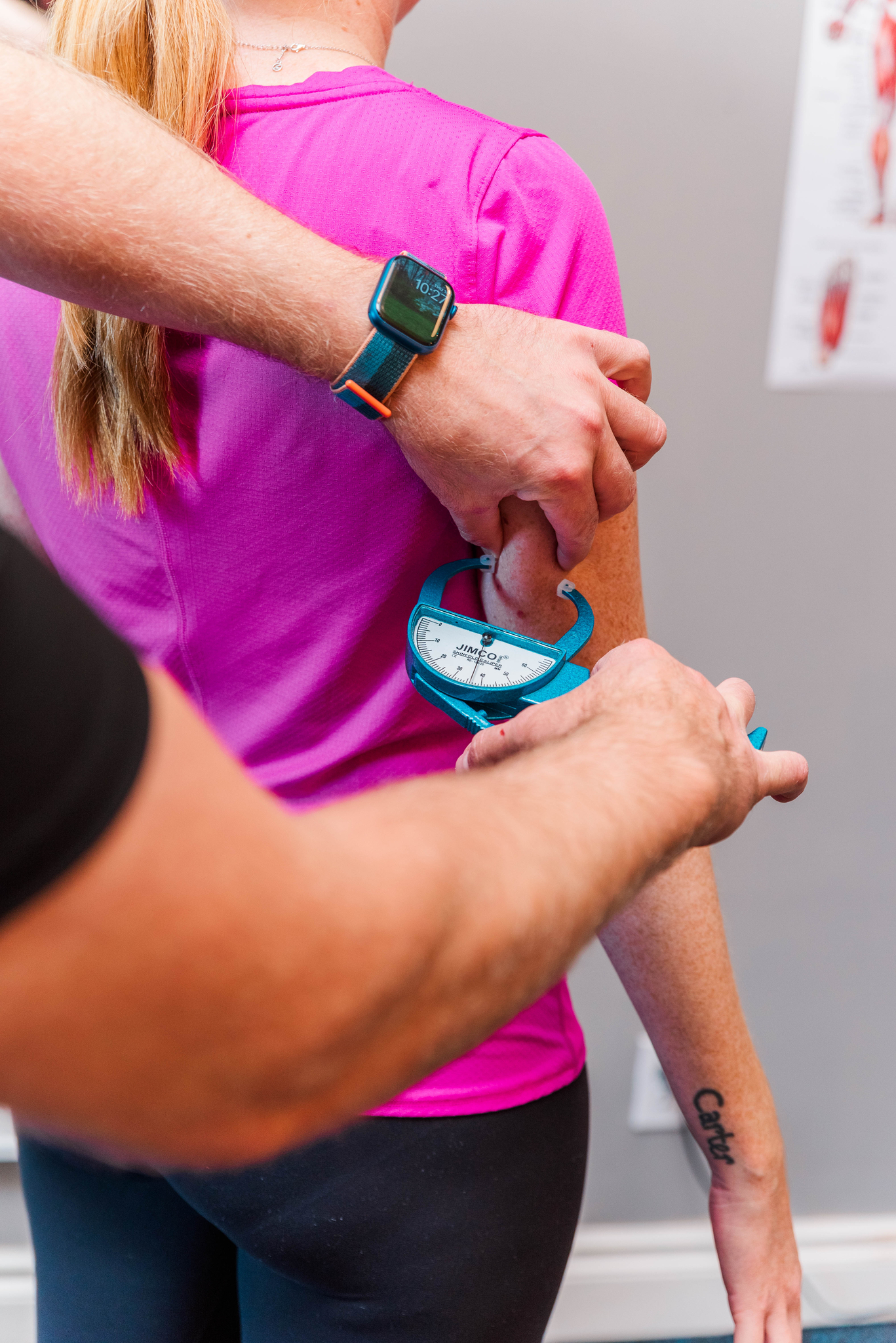
Using a measuring tape to track changes in key areas such as the waist, hips, chest, arms, and thighs can be helpful for our in-home and virtual personal training clients who have an unhealthy amount of excess fat. If progress is feeling slow or hard to see in pictures, a definite change in measurement can provide proof of progress. That said, this can be an uncomfortable process for some, and we’d never push measurements on those who aren’t interested.
CLOTHING
One of the easiest ways to track progress is by paying attention to how your clothes fit. If your jeans feel looser around the waist or your shirt feels less snug around your arms, it’s a sign that your body is changing — even if the scale doesn’t reflect it.
A favoured method is to choose an old pair of pants that may not fit you well and take your progress photos in them. Watch how the fit improves when you revisit the same pair in pictures down the road!
ENERGY
On top of being popular goals for our in-home and virtual personal training clients, improved mood and better focus are both strong indicators of fitness. Along with a hit of endorphins, “exercising also boosts oxygen circulation inside your body. This increase in oxygen not only supports the mitochondria’s energy production, it allows your body to function better and to use its energy more efficiently. Plus, your body gets a boost from an exercise-induced increase in hormone levels that makes you feel more energized” (Harvard Health, 2021). If you find yourself feeling more energetic throughout the day or experiencing improved mental clarity, it’s a good indication that your health is improving.
RESTING HEART RATE AND RECOVERY
A lower resting heart rate and quicker post-workout recovery are both telltale signs of improved cardiovascular fitness. “For most adults, a resting heart rate between 60 and 100 beats per minute is normal. However, the rate can be affected by factors such as stress, anxiety, hormones, medication and how physically active you are. An athlete or more active person may have a resting heart rate as low as 40 beats per minute” (American Heart Association, 2024). Using a fitness tracker or manually checking your pulse can help monitor these changes. An in-home or virtual personal trainer can also monitor your breathing rate with talk-tests: we make strategic conversation during moments of physical challenge or recovery to check-in with cardio conditioning.
FLEXIBILTY & MOBILITY
Increased flexibility and better mobility are important indicators of overall fitness. If you find that you can stretch deeper, touch your toes, or move more comfortably during workouts, you’re making progress.
SLEEP
Regular exercise often leads to improved sleep quality. “Studies have found that proper exercise can alleviate sleep-related problems and help you get an adequate amount of rest. Recent research also suggests insufficient or poor-quality sleep can lead to lower levels of physical activity the following day” (Sleep Foundation, 2023). If you notice that you’re falling asleep faster, staying asleep longer, and waking up more refreshed, it’s a great sign that your fitness routine is benefiting your overall health. This is why our in-home and virtual personal trainers ask about sleep quality during initial consultations.
CAPABILITY
Most importantly, fitness progress isn’t just about appearance: it’s about performance. Keep track of how much weight you can lift, how many reps you can do, or how far and fast you can run to see the real difference in how you feel. Increasing your strength and endurance is the best way to transform your day to day life and longevity. Our in-home and virtual personal trainers use progressive overload to ensure clients remain challenged.
CLOSE
Tracking your fitness progress without using a scale allows you to focus on overall health, strength, and well-being rather than just numbers. We encourage you to pay attention to how you feel and perform to stay motivated and committed to your fitness journey. We’re here to help you become the healthiest version of yourself! You can contact our team, here.