
Fitness Functional Strength Injury Prevention
September 16th, 2025
Shoulder Mobility: Why it’s Important
One of the most common areas our in-home and virtual personal trainers see clients struggle with is shoulder mobility. Today, we’re diving deep into why shoulder mobility matters, how it impacts daily life, and what you can do to improve it.
“Mobility is defined as your ability to move purposefully as you go through your day. It is the foundation for living a healthy and independent life. Mobility comprises all the skills required for everyday living: physical stamina, strength, balance, coordination, and range of motion” (Harvard Health, 2022).
One of the most common areas our in-home and virtual personal trainers see clients struggle with is shoulder mobility. The shoulders play a crucial role in nearly every movement we perform, but unfortunately, they’re one of the most vulnerable joints in the body.
This makes shoulder mobility work not just beneficial, but essential for long-term healthy function. Today, we’re diving deep into why shoulder mobility matters, how it impacts daily life, and what you can do to improve it.
THE BASICS OF SHOULDER MOBILITY
The shoulder is a ball-and-socket joint that allows for an incredible range of motion: lifting, pushing, pulling, and rotating. In fact, it’s the most mobile joint in the body, but that mobility comes at the cost of stability. Unlike the hip joint, which is supported by a deep socket, the shoulder relies heavily on muscles, tendons, and ligaments for support.
This makes it more susceptible to stiffness, injury, and overuse. When mobility is restricted, these movements become inefficient and can even be painful. Over time, poor mobility may contribute to compensation patterns that put unnecessary strain on the neck, spine, and lower back.
THE SHOULDER MOBILITY GAP
Many people spend hours in the gym building shoulder strength with presses, lateral raises, and push-ups, but very few dedicate enough time to mobility work. Strength without mobility can actually make you more prone to injury. Think of it this way: if you’re strong enough to lift heavy weights overhead but lack the mobility to do it with proper form, your body will find a way to compensate — often by arching your back or straining smaller stabilizing muscles.
When we work with our in-home personal training clients in Toronto, Collingwood, London, Hamilton, and Ottawa (and virtual clients everywhere), we often find that addressing mobility first unlocks better performance in nearly every other area of fitness. Once the shoulders move freely, strength and stability can develop safely.
THE ROLE OF POSTURE IN SHOULDER MOBILITY
Modern lifestyles don’t do our shoulders any favours. Hours of sitting at a desk, driving, or scrolling on phones encourage a rounded posture where the shoulders hunch forward, AKA, forward head posture (FHP). FHP “refers to the head sitting forward, out of alignment with the neck. This is the most common postural problem on the sagittal plane, which is an anatomical line dividing the body into left and right halves.
When standing with a FHP, a person’s head is too far forward, with the ears in front of the shoulders. This can create a rounded appearance in the upper back. When sitting with a FHP, a person may look as if they are slouching” (Medical News Today, 2024).
This position shortens the chest muscles while weakening the muscles of the upper back, creating an imbalance that limits mobility. We often remind clients that posture isn’t just about standing tall — it directly affects the health of your shoulders. Restoring mobility starts with awareness of how you sit, stand, and move throughout the day. Small adjustments, like setting up an ergonomic workstation or taking frequent breaks to stretch, can go a long way in maintaining shoulder health.
SHOULDER MOBILITY AND DAILY FUNCTION
If you think shoulder mobility is only important for athletes, think again. Everyday tasks such as reaching for a shelf, putting on a jacket, or picking up a child all depend on the shoulders. When mobility is limited, these seemingly simple activities become uncomfortable, and over time can lead to chronic pain
Clients who come to us for training often realize that what they considered “aging pains” are actually mobility issues. By improving shoulder movement, we’ve seen people regain confidence in activities they thought they’d lost — like golfing, gardening, or even just sleeping comfortably without pain.
SHOULDER MOBILITY AND SPORTS
For those who play sports or exercise regularly, shoulder mobility can make the difference between peak performance and frustrating setbacks. A tennis player relies on mobility to swing efficiently, a swimmer to rotate smoothly, and a weightlifter to press overhead with proper form.
Without adequate mobility, technique breaks down, and injuries like impingement, rotator cuff strains, and tendonitis become more likely. In our role as in-home and virtual personal trainers, we emphasize that mobility is performance-enhancing. It’s not just about injury prevention; it’s about unlocking your full potential in whatever activity you enjoy.
THE CONNECTION BETWEEN STRENGTH AND MOBILITY
Strength training and mobility training are deeply interconnected. When shoulders move through their full range of motion, you can engage muscles more effectively. Clients who struggle with mobility often hit plateaus in strength training. They might avoid certain exercises or perform them with poor form. Prioritizing mobility will improve your lifts and recovery while reducing nagging discomfort that can hold you back.
THE RISKS OF NEGLECTING SHOULDER MOBILITY
Aside from performance gains, neglecting mobility can lead to long-term issues. Frozen shoulder, rotator cuff tears, and chronic impingement are common results of poor shoulder care. Once these conditions develop, they can take months or even years to rehabilitate.
As in-home and virtual personal trainers, we would much rather help clients prevent these issues than see them sidelined by injury. That’s why we stress that mobility work isn’t optional — it’s foundational. Think of it as brushing your teeth: a small daily effort that prevents big problems later on.
HOW PERSONAL TRAINING CAN HELP WITH SHOULDER MOBILITY
When working with clients – whether in a condo gym, in-home, or through virtual personal training – we always begin with an assessment of mobility. From there, we integrate exercises that improve flexibility, stability, and control.
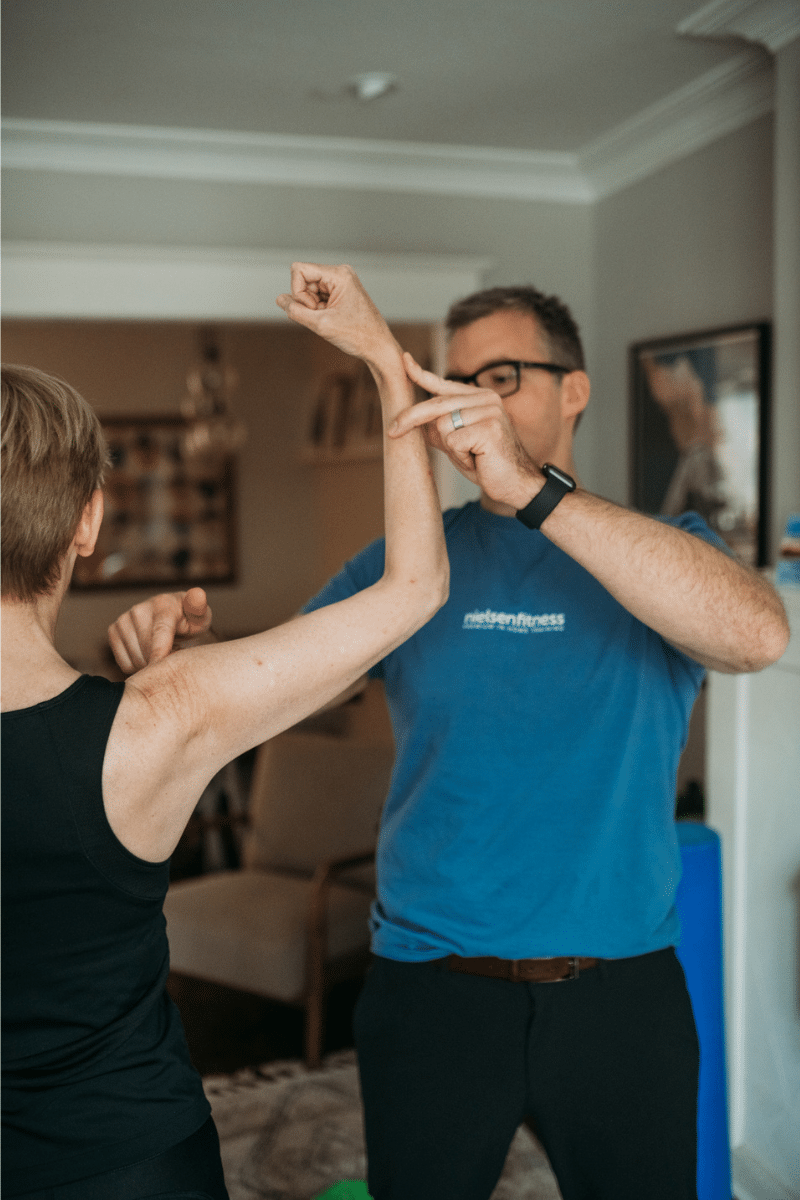
Mobility drills might include controlled articular rotations, wall angels/slides, or banded stretches. We also teach clients how to engage their scapular stabilizers, which support the shoulder joint. These movements may seem simple, but when practiced consistently, they dramatically improve how the shoulders feel and function.
THE IMPORTANCE OF CONSISTENCY
Improving shoulder mobility requires consistency. Just as you wouldn’t expect to get stronger from lifting weights once a month, you can’t expect mobility improvements without regular practice. That’s why we encourage clients to make mobility part of their warm-up, cool-down, or even daily routine outside of workouts. We often assign “homework” exercises: quick mobility drills that take only a few minutes but compound into big improvements over time.
SHOULDER MOBILITY AND AGEING
As we age, maintaining mobility becomes even more important. “Mobility limitation is associated with loss of functional independence and is a marker for disability, falls, hospitalization, institutionalization, and mortality in older populations” (National Library of Medicine, 2023).
Natural changes in tissue elasticity, combined with years of postural habits, can lead to stiffness. However, it’s never too late to improve. We’ve worked with clients in their 60s, 70s, and even 80+ who’ve regained significant range of motion with consistent training. Shoulder mobility helps older adults maintain independence, making it easier to reach overhead, lift objects, and stay active. More importantly, it reduces the risk of falls and injuries by allowing for better movement coordination.
FINAL WORDS
Shoulder mobility is often ignored until pain sets in, but we believe it should be at the forefront of any fitness routine. Strong, mobile shoulders enhance performance, improve posture, support daily activities, and protect against injury. We’ve seen firsthand how clients transform when they commit to mobility work. Make shoulder mobility a priority and your future self will thank you!