
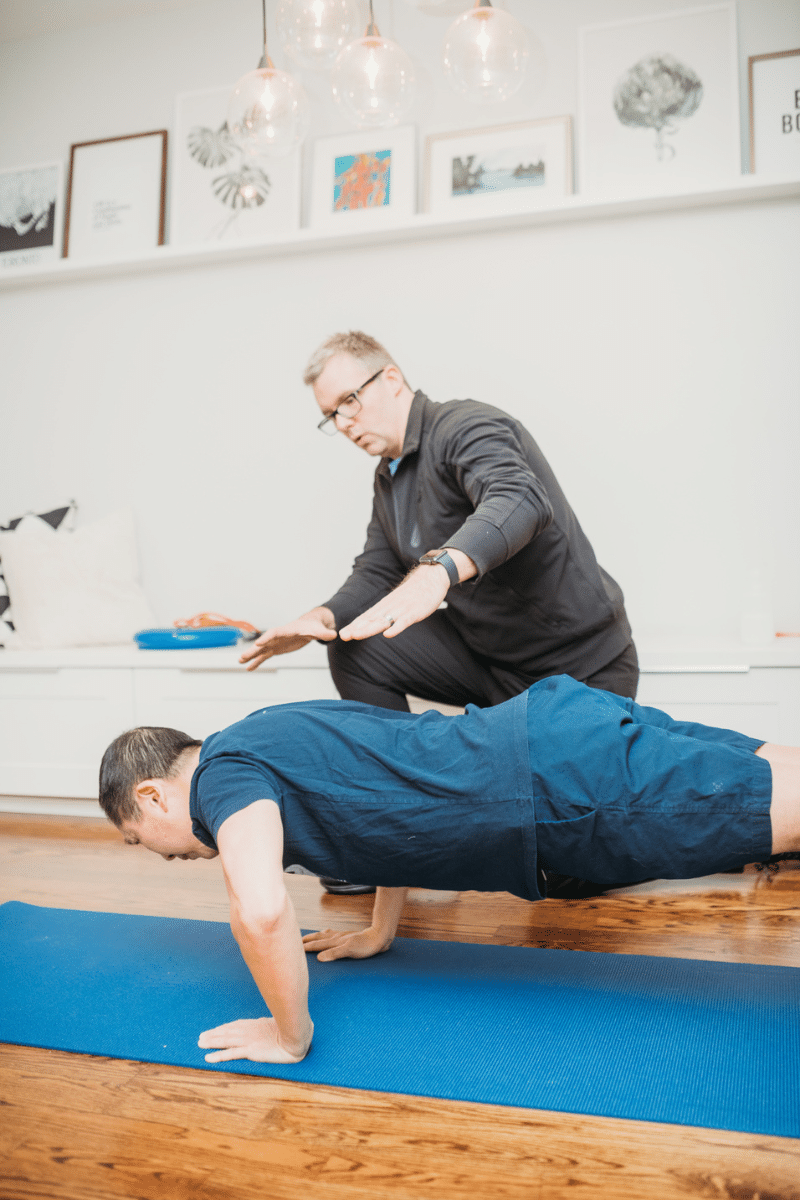
If you’re strength training after 40, you’ve probably accepted that exercise is important. If you already make time to train, you want to know you’re doing the right things. As a team of professionals providing in-home personal training in Toronto, Collingwood, Hamilton, Ottawa, and London (and virtual personal training across the globe), we know that busy adults aren’t looking for random workouts. They’re looking for an efficient, evidence-based way to improve strength and protect their health. Let’s talk about why regular strength training after 40 is one of the best investments busy adults can make.
STRENGTH TRAINING PRESERVES CAPACITY
After 40, strength training becomes highly focused on maintenance. Beginning in our 30s, adults naturally begin losing muscle mass and strength. Left unaddressed, that gradual decline accelerates through the 40s and 50s. Balance becomes less automatic, recovery slows, and joint discomfort becomes more common. Everyday tasks begin requiring more effort than they once did. The good news is that strength training after 40 remains one of the most effective ways to slow, and often reverse many of these changes.
The goal is to invest in physical abilities that will determine how well you move over the next several decades. For example, practicing weighted step-ups will support your ability to carry luggage up several flights of stairs without thinking about it. Goblet squats make it easier to lift your kids without hurting your back. Choose movements that transfer directly into the functions you need to enjoy your life, as these are the markers of physical independence.
STRENGTH TRAINING AFTER 40 AND YOUR BRAIN
Perhaps the most fascinating area of research emerging over the past several years has to do with strength training after 40 and the brain. Researchers have repeatedly found associations between lower-body strength and long-term cognitive health. Those with stronger legs often demonstrate slower rates of cognitive decline as they age compared to those with weaker lower-body strength.
Strong legs reflect healthy muscle tissue, efficient circulation, and good nervous system function. Any form of exercise can boost blood flow to the brain, but because “the muscles in your legs are among the largest in the body, they require more oxygen and nutrients—prompting your heart to pump more blood overall. Greater blood and oxygen delivery to the brain is linked to improved focus and mental clarity, both inside and outside of the gym” (Health, 2026).
This changes how we think about strength training after 40. Leg exercises maintain one of the body’s largest and most metabolically important muscle groups while supporting long-term mobility, balance, independence, and potentially even cognitive resilience. Even practicing simple bodyweight squats on a regular basis can make a difference.
THE WINDOW GETS NARROWER THAN MOST PEOPLE THINK
You can absolutely begin strength training at 50, 60, or beyond. However, introducing these movement patterns becomes progressively more challenging the longer you wait. During your early and mid-40s, your body is generally still highly adaptable. Your nervous system learns movement efficiently, your muscles respond well to progressive overload, and connective tissues continue adapting well to consistent training. By your late 40s and 50s, these adaptations are still possible, they simply take more time.
For example, practical exercises like split-squats for single-leg stability and unilateral conformity (equal strength and control on both sides of the body) are regularly used in strength training after 40 sessions, but we see clients who begin learning these movements later in life face a tougher challenge. Balance and coordination require more deliberate attention as you age. The longer you go without practice, the harder they will become. We’re here to support you from wherever you’re beginning, but it can be harder to stay motivated when workouts feel intimidating.
This isn’t meant to discourage anyone from starting later in life. It’s a reminder that beginning now gives your future self a significant advantage. Strength isn’t something you build overnight, but something you accumulate over years.
PRECISION MATTERS MORE THAN INTENSITY
One mistake we see among busy professionals is believing they need harder workouts. More often, lasting change comes from repeating simple, effective training week after week. A well-designed strength program focuses on movement quality before exercise quantity. Proper technique protects joints, improves efficiency, and allows consistent progress without unnecessary setbacks. This matters even more when strength training after 40. Personalized coaching consistently produces better outcomes than trying to piece together random, over-complicated workouts from social media. The benefits accumulate quietly until one day you realize you’re still capable of doing things many people your age have already given up.
Whether clients choose virtual personal training or in-home personal training in Toronto, every exercise is selected with a purpose. Instead of chasing trends, clients follow a structured progression that builds strength safely and efficiently. This simple precision allows consistency, and consistency is where meaningful results happen. “You don’t need to lift the heaviest weights in the gym or push yourself to exhaustion. What matters more is showing up regularly, building strength gradually, and making it a habit you can sustain for years. Even short, steady sessions a few times a week can add up to meaningful gains in muscle, metabolism, and overall health” (Time, 2025).
THE BEST TIME TO BUILD STRENGTH IS BEFORE YOU NEED IT
Most people don’t think seriously about strength until they begin noticing what they’ve lost.
The smarter approach is to build it before those losses become obvious. Every year you spend developing strength, coordination, and movement quality becomes another year of investment in your future mobility and resilience. It becomes easier to stay active, recover from setbacks, and maintain the physical confidence that supports every other aspect of life. As trainers, we don’t view strength training as preparation for your next vacation or your next beach season. We view it as preparation for the next 20 or 30 years.
If you’re already motivated to improve your health, don’t waste time searching for the most intense workout. Look for the most effective one. A personalized strength program gives you a clear plan built around safe progression, efficient movement, and long-term results.
After 40, strength isn’t just another fitness goal. It’s one of the most important investments you can make in your future. Learn more in part 1!