
February 28th, 2025
The Importance of Building and Maintaining Strong Hips
Having strong hips is essential for fitness as well as general mobility. As in-home and virtual personal trainers, we play an important role in helping clients build and maintain strong hips through tailored exercise programming. Read on to learn why hip strength matters, how the team at Nielsen Fitness can assist, and a few examples of our favourite hip-strengthening exercises.
Strong Hips: Why They’re Essential for Mobility and Health
THE BASICS
Your hips are ball and socket joints that provide a wide range of motion, allowing you to walk, run, jump, and rotate your legs. “You might be surprised to learn how many muscles are needed to move your hips. They’re categorized into four groups: flex (bend), extend (stand), abduct (move outward), and adduct (move inward)” (Very Well Fit, 2024). The gluteus maximus is responsible for extending your hip and generating power, while the gluteus medius and minimus help stabilize your pelvis and support lateral movement. Hip flexors (located at the front of your hips) allow you to lift your knees and bend at the waist. The adductors (inner thighs) bring your legs together, while the abductors (outer thighs) help lift your legs to the side. Together, these muscles maintain your hip alignment, balance, and mobility, reducing strain on your lower back and knees.
HIP STRENGTH
Your hips are a central part of your body. Keeping them strong is essential for good posture, injury prevention, and the maintenance of mobility as you age. This is why hip strength is a key element of many of the programs designed for our older-adult clients. “You need to be able to keep your joints in a stable position while both moving and not moving” (Livestrong, 2023). Strengthening the muscles surrounding your hips improves balance, flexibility, stability, and strength, improving ease of movement in daily life.
For example: “When you’re sitting, whether you’re at your desk for the whole morning, on a long road trip in a car, or stuck on a ten-hour flight to Europe, your hip flexors, the muscles that help bring your thigh to your chest, wind up trapped in a shortened position, unable to stretch out. Your glutes, meanwhile, are in an ultra-relaxed, stretched position. When you stand, you’re often left with a nagging tightness in the front of your hips” (Men’s Health, 2024). The glutes and the hip flexors both support the hip joint, so it’s vital to counteract this effect with exercises that combat the imbalances created by excessively lengthened or shortened muscles.
HOW WE CAN HELP
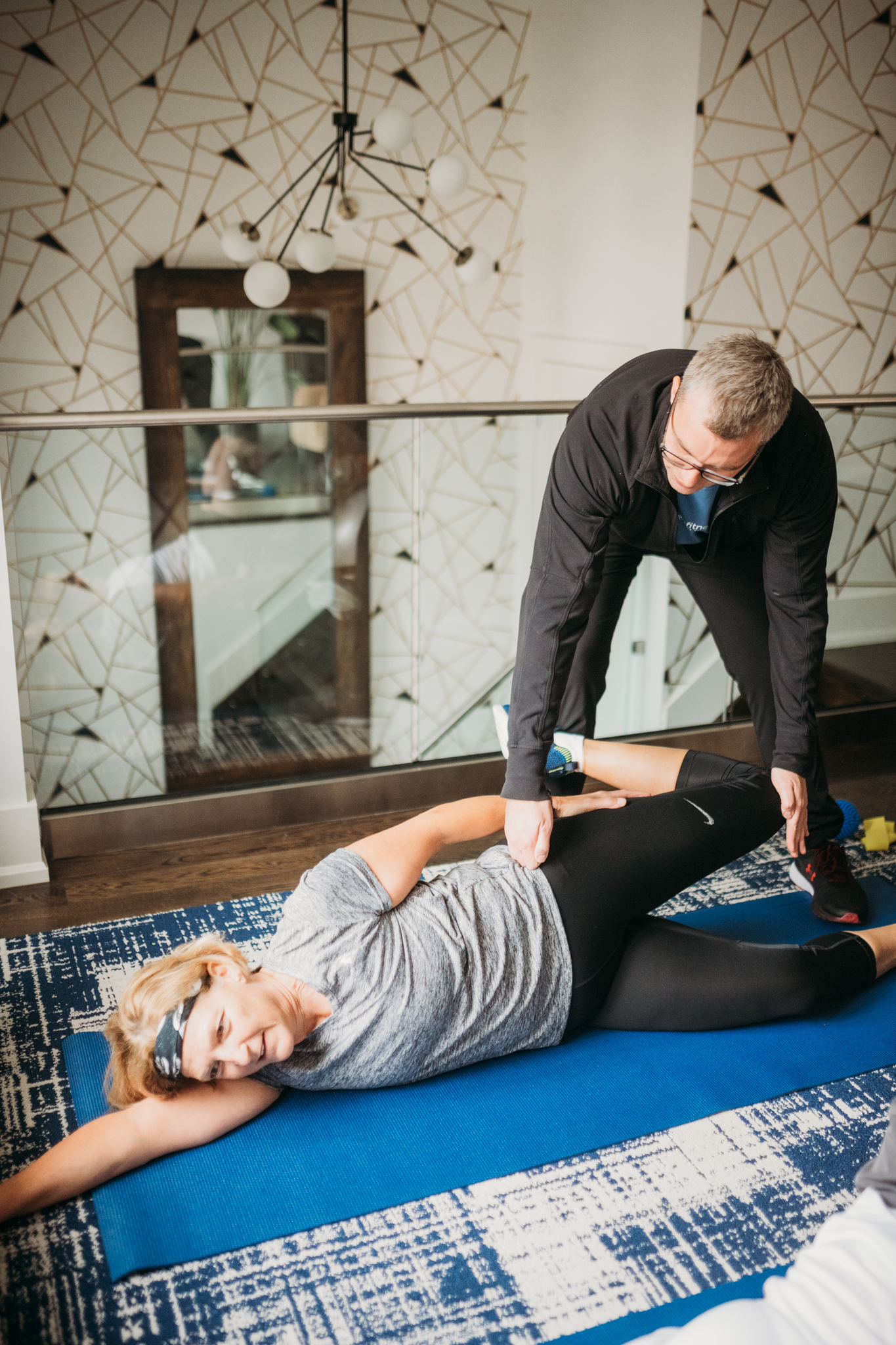
Our in-home personal trainers in Toronto, Collingwood, London, Hamilton, and Ottawa (and virtual personal trainers everywhere) can assess your current hip strength and mobility, identify any imbalances or weaknesses, and design customized workouts to address these areas. We’ll ensure you use proper form, which maximizes the effectiveness of exercises while preventing injuries. In-home and virtual personal trainers also provide motivation and progressive challenges, helping you stay consistent and achieve long-term results.
OUR FAVOURITE MOVES
(… which you can see demonstrated here!)
Glute Bridges: Lie on your back with your knees bent and your feet flat on the floor, hip-width apart. Press through your heels to lift your hips toward the ceiling, maintaining core engagement and squeezing your glutes at the top. Lower your hips back down and repeat for 10-15 repetitions.
Clam Shells: Lie on your side with your knees bent and stacked on top of each other. Keep your feet together as you lift your top knee, opening your legs like a clam shell. Lower your knee back down and repeat without letting your hips roll backward; keep them stacked. To maintain constant core engagement, imagine you’re trying to lift your waist off the floor during the movement. Perform 10-15 reps per side.
Lateral Band Walks: Place a looped resistance band around your legs just above your knees. Stand with your feet hip-width apart, slightly bending your knees. Take small steps to the side, keeping tension on the band. Maintain an active core. Step 10-15 times in each direction.
Standing Hip Abduction: Stand tall with a braced core. Lift one leg out to the side, keeping your toes pointing forward and without leaning to the left or right. Lower your leg with control and repeat for 12-15 reps per side. If you struggle to keep your balance, use a chair for assistance until you’re strong enough to do the exercise unsupported.
FINAL WORDS
Building and maintaining strong hips is essential for everyday movements as well as athletic performance. Try incorporating these hip-strengthening exercises into your routine to improve your balance, stability, and overall strength. If you need assistance mastering the moves, you can reach our team here!