
August 28th, 2026
Squat 101: The Powerful Truth About Your Unique Squat
If you’ve ever compared your squat to someone else’s, you may have assumed that one of you must be doing it wrong. Maybe their feet are wider, their toes point out more, their torso stays more upright, or they comfortably reach a depth that you can’t.
As a team of personal trainers, we want you to know something important: your squat does not need to look like anyone else’s.
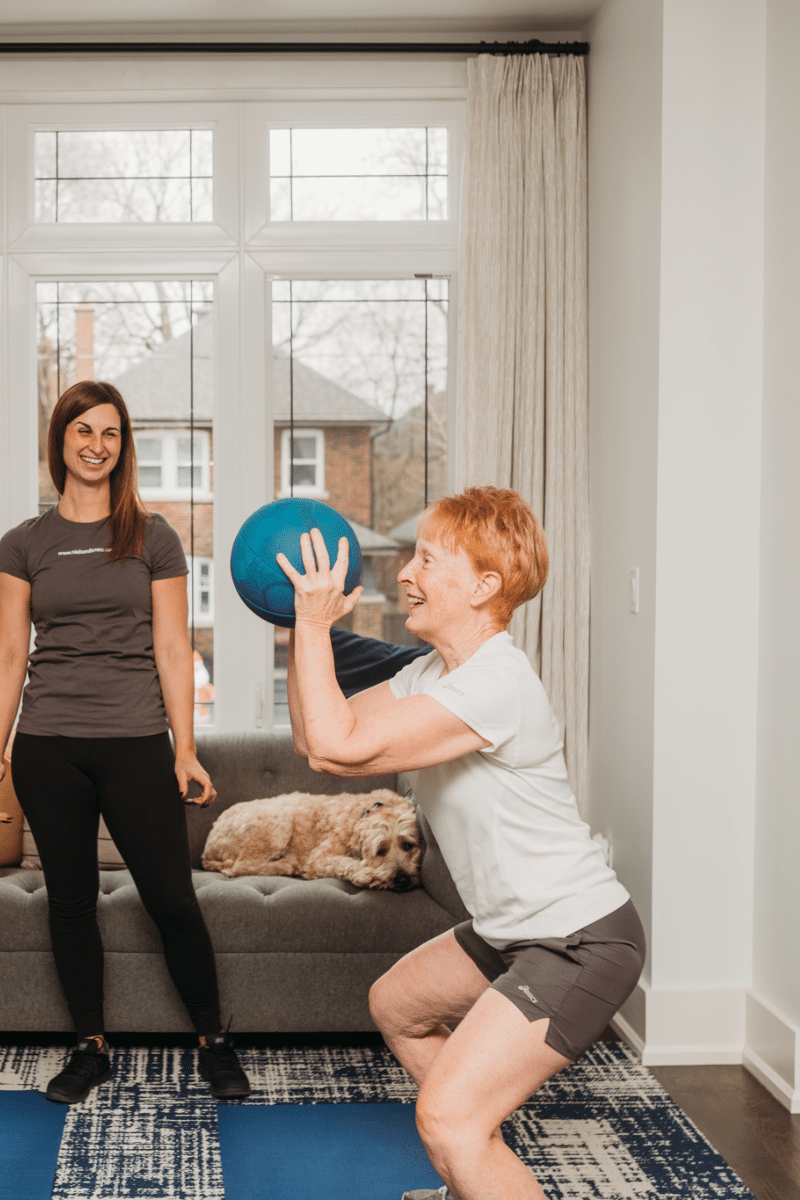
A squat is a movement pattern, not a pose. Your proportions, mobility, strength, experience, and training goals all influence how that movement looks. Trying to force your body into somebody else’s squat can distract you from what actually matters: moving with control, training the muscles you intend to train, and gradually becoming stronger and more capable.
TIP ONE: FIND YOUR NATURAL STARTING POSITION
The first thing you can do is find your foot position. Start by standing with your feet roughly where they would naturally land, then perform a slow bodyweight squat. Pay attention to how your hips, knees, and ankles feel as you descend. Experiment with making your stance slightly narrower or wider and allow your toes to turn out comfortably rather than forcing them to point straight ahead. Your knees should track over your toes without caving in or out.
You may immediately notice that one position feels smoother and gives you more room to move. That is useful information. “Suitable stance width and foot placement angles should be chosen according to the targeted joint moments” (Lorenzetti, PubMed, 2018), and different body proportions can affect joint positions during the squat.
In other words, there is a reason your ideal stance may not match your trainer’s, your workout partner’s, or the person you saw demonstrating a squat online. When you are doing this yourself, think less about making your feet look perfect and more about finding a position that allows you to descend and stand with control. Small adjustments can make a meaningful difference.
YOUR BODY PROPORTIONS CHANGE THE MOVEMENT
Your skeleton influences your squat before you even start adding weight. The relative lengths of your torso, thighs, and lower legs affect how your body has to organize itself to keep your balance. Someone with longer femurs may naturally lean their torso forward more during a squat. Someone with different proportions may remain more upright. Neither person automatically has better technique.
This is one reason visual comparisons can be misleading. You may copy someone’s stance and posture without having the same proportions that made their position comfortable and effective in the first place. The goal of private training is not to make you look like your trainer. It is to help you understand how your own body moves and determine which adjustments help you perform an exercise effectively.
TIP TWO: STOP CHASING DEPTH
Your second practical takeaway is to stop treating squat depth as a universal test of fitness.
Going deeper is not automatically better. The appropriate depth depends on your mobility, anatomy, strength, exercise variation, load, and training objective.
A 2024 biomechanical review explains that squat performance can be modified through several variables, including stance width, foot rotation, trunk position, tibia position and depth (Straub and Powers, PubMed, 2024). That means you can make the squat work for your current abilities instead of forcing yourself into a predetermined position.
Try performing several slow bodyweight squats and use the deepest range where you can repeatedly maintain control without hunching your shoulders, rounding your lower back, or collapsing in the knees. If you lose control, compensate dramatically, or experience pain, reduce the range and seek appropriate professional guidance rather than forcing yourself lower.
Over time, your range may change as your strength, confidence, and mobility develop. Your squat does not have to look the same today as it will six months from now.
YOUR TECHNIQUE SHOULD SERVE YOUR GOAL
It’s also important to remember that everyone has unique training goals. Your squat might be part of a program designed to build general strength. Someone else’s might be focused on powerlifting performance. Another person’s squat might be helping them develop strength for everyday activities.
The exercise has the same name, but the purpose is different. That is why effective coaching looks beyond whether a movement resembles an ideal image. We consider the load, range of motion, tempo, equipment, experience and desired training effect. A bodyweight squat, goblet squat, box squat, and barbell squat can all be valuable without needing to look identical.
TIP THREE: RECORD YOUR OWN PROGRESS
Your third practical tip is simple: compare your squat with your previous squat, not somebody else’s. Take a short video of your bodyweight squat from the side or front. Keep the set-up consistent and repeat the recording every few weeks. Instead of obsessing over whether every joint matches a textbook position, look for meaningful improvements in control, confidence, consistency, and strength.
This gives you a much better measure of progress. If your stance becomes slightly wider, your toes turn out a little more, or your torso angle changes as you become stronger, that does not necessarily mean your technique is getting worse. It may simply mean your body has found a movement strategy that suits you.
Research continues to show that changing squat stance changes the mechanical demands placed on the body. A 2024 study found that increasing stance width increased hip extensor and lateral-rotator demands, demonstrating that even a seemingly small change can alter how the exercise is performed (Hopkins, PubMed, 2024). Your job is not to eliminate every difference. Your job is to understand which differences help you.
BETTER COACHING STARTS WITH THE INDIVIDUAL
This is where individualized private training can make a real difference. Instead of giving you a generic squat checklist and expecting you to fit yourself into it, we can look at your movement as a whole. We consider your goals, your current strength, your mobility, your proportions and your experience, then adjust the exercise accordingly.
Sometimes that means changing your stance. Sometimes it means adjusting your depth. Sometimes it means choosing a different squat variation while you build the strength and confidence to progress. Most importantly, it means you stop viewing your body as a problem that needs to imitate somebody else’s solution.
START TRAINING FOR YOUR BODY
You do not need to figure out your perfect squat alone. Book your free initial consult and mini workout with Nielsen Fitness and experience an individualized approach to training firsthand. We’ll help you understand where you are now, identify what you need, and show you how training can be built around your body rather than forcing your body to fit a template.